

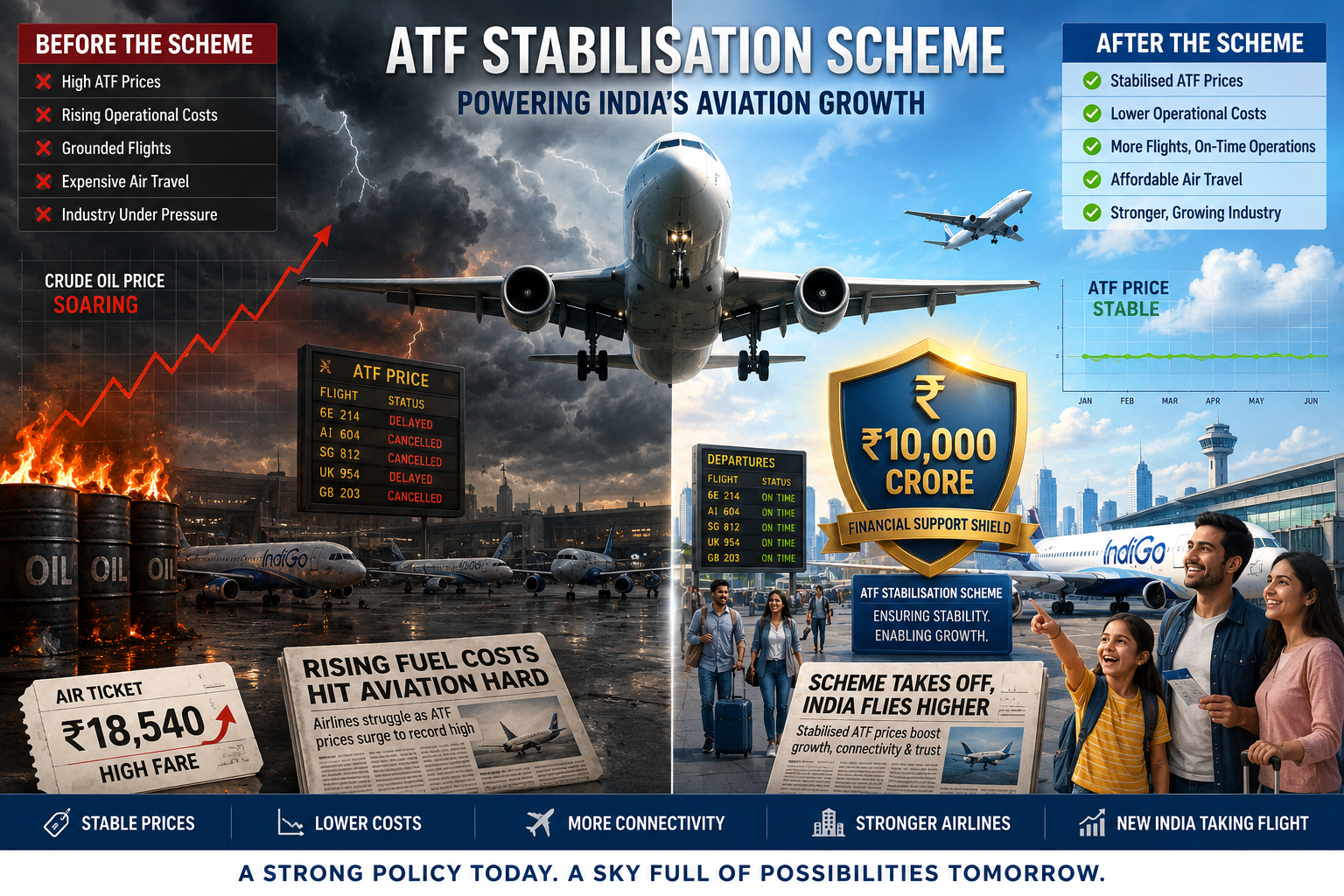
India’s Union Cabinet has taken a major step to shield the country’s aviation industry from volatility in global oil markets by approving a ₹10,000-crore Aviation Turbine Fuel (ATF) Price Stabilisation Fund. The initiative aims to protect airlines from sudden fuel price shocks and help prevent sharp increases in airfares for passengers.
Following the decision, state-owned Oil Marketing Companies (OMCs) introduced a new voluntary fixed-pricing framework for domestic airlines. Under the scheme, the ATF price for participating carriers has increased from around ₹105 per litre to approximately ₹115 per litre.
Why This Decision Matters
Aviation Turbine Fuel is one of the largest expenses for airlines, accounting for nearly 40% to 60% of their operating costs. As a result, any increase in global crude oil prices directly affects airline profitability and often leads to higher ticket prices for passengers.
Recent geopolitical tensions in West Asia, supply concerns in international energy markets, and fluctuations in crude oil prices have significantly increased jet fuel costs worldwide. The pressure has already forced major Indian carriers such as Air India and IndiGo to reduce approximately 250 daily flights collectively, tightening seat availability and pushing fares higher.
How the Stabilisation Fund Will Work
The government’s new mechanism is not a direct subsidy. Instead, it acts as a financial buffer designed to reduce the impact of extreme fuel-price volatility.
Key Features of the Scheme
- Total Fund Size: ₹10,000 crore
- Nature of Support: Interest-free advances to state-owned Oil Marketing Companies
- Benchmark Price: ₹86.32 per litre (FOB basis)
- Duration: Up to 36 months or until the fund is fully recovered
What Happens When Global Fuel Prices Rise?
If international ATF prices rise significantly above the benchmark level, the stabilisation fund will compensate OMCs for a portion of the difference. This allows them to continue supplying fuel to participating airlines at the pre-determined fixed rate.
The primary objective is to prevent sudden spikes in airline operating costs and reduce the need for abrupt airfare increases.
What Happens When Fuel Prices Fall?
If global fuel prices decline below the benchmark, OMCs will return the excess gains to the Consolidated Fund of India.
This self-correcting structure is designed to ensure that the scheme does not become a permanent fiscal burden on the government.
The Strategic Choice Before Airlines
Participation in the scheme is entirely voluntary, leaving airlines with two distinct options.
Option 1: Join the Fixed-Price Framework
Airlines that opt into the programme can purchase ATF at approximately ₹115 per litre, subject to local tax variations at different airports.
Benefits
- Protection against future fuel price spikes
- Greater cost predictability
- Easier long-term financial planning
- Reduced pressure to frequently adjust ticket prices
Option 2: Remain on Market-Based Pricing
Airlines that stay outside the scheme will continue purchasing fuel at market-linked Import Parity Prices (IPP), currently estimated at around ₹142 per litre.
Benefits
- Opportunity to benefit if global oil prices decline significantly
Risks
- Full exposure to future geopolitical or supply-driven price shocks
- Potential need for frequent airfare hikes during fuel crises
Impact on Passengers
In the short term, the increase in the fixed ATF price to ₹115 per litre may place some additional cost pressure on airlines, potentially leading to modest fare increases on certain routes.
However, aviation analysts believe that over the longer term, the scheme could benefit passengers by reducing the frequency and severity of airfare spikes caused by global energy market disruptions.
Business travellers, tourists, and middle-class passengers could ultimately gain from greater fare stability and more predictable pricing.
Significance for India’s Aviation Industry
India is one of the world’s fastest-growing aviation markets, with passenger demand expected to expand rapidly over the next decade.
The stabilisation mechanism could provide several long-term benefits:
- Lower financial risk for airlines
- Improved business planning and budgeting
- Greater confidence for investors
- Enhanced route expansion opportunities
- Better operational stability during global energy crises
By reducing uncertainty surrounding fuel costs, the policy may strengthen the resilience of India’s aviation sector and support its long-term growth ambitions.
The ₹10,000-crore ATF Price Stabilisation Fund represents a significant policy experiment in India’s aviation sector. Rather than offering a traditional subsidy, the government is attempting to create a protective buffer against extreme fluctuations in global fuel prices.
While the immediate increase in fixed ATF prices may create some short-term cost pressure, the scheme’s long-term goal is to provide stability for airlines, protect passengers from dramatic fare increases, and strengthen the resilience of India’s aviation industry against future energy shocks.
Ultimately, the success of the initiative will depend on global oil market trends and the extent to which airlines choose to participate. Nevertheless, many industry observers view it as a potentially transformative step in India’s aviation policy framework.
About The Author
Discover more from Jist Feed
Subscribe to get the latest posts sent to your email.