

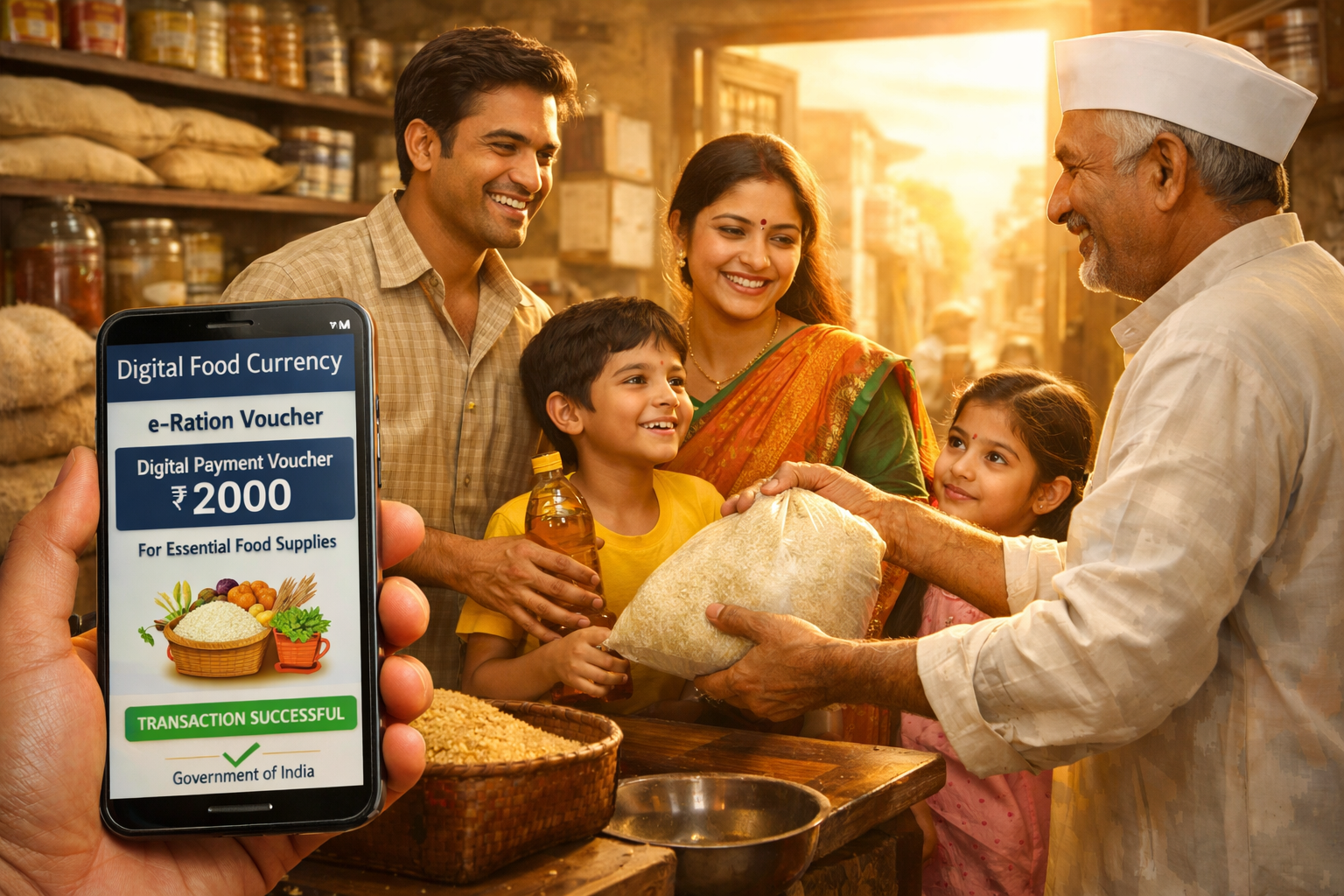
For millions of low-income families in India, the monthly ration from government schemes is a lifeline. However, the traditional system has often been criticised for delays, corruption, or technical failures during biometric verification. Digital Food Currency is an attempt to solve many of these problems.
Instead of standing in long queues or depending on middlemen, beneficiaries will receive a digital food voucher directly from the government. This voucher can only be used to collect food grains from authorised ration shops or automated grain machines.
In simple terms, it works like a ration coupon in digital form, but much safer and more transparent. Every transaction is recorded digitally, making it easier for the government to track subsidy delivery and prevent misuse.
If implemented successfully across the country, this system could transform the way food subsidies reach millions of households that depend on them for daily survival.
How is Digital Food Currency different from normal money ?
Normal money can be used for any purchase. Digital Food Currency is programmable money, which means it is restricted and can only be used for food purchases under government welfare schemes.
Who will benefit from Digital Food Currency ?
People who receive food subsidies through the Public Distribution System (PDS) or schemes like Pradhan Mantri Garib Kalyan Anna Yojana (PMGKAY) will benefit the most. The system ensures that subsidies reach the right beneficiaries directly.
Does Digital Food Currency require a smartphone?
No. The system is designed to work even on basic feature phones using SMS vouchers, so people without smartphones or internet access can also use it.
Why is India introducing Digital Food Currency?
The main goal is to reduce corruption, eliminate middlemen, and ensure that food subsidies are used only for buying essential food grains.
Where has Digital Food Currency been tested?
Pilot projects have already started in Puducherry and Gujarat, and the government plans to expand the system to other regions in phases.
Why India Needs Digital Food Currency
India runs one of the largest food security programs in the world.
- Around 80 crore (800 million) people receive free or subsidised food grains under the Pradhan Mantri Garib Kalyan Anna Yojana (PMGKAY).
- The Public Distribution System (PDS) distributes millions of tonnes of food grains every year.
- Food subsidy expenditure in India crossed ₹2 lakh crore annually in recent years.
However, traditional systems sometimes face issues such as:
- Fake beneficiaries
- Leakage and corruption
- Middlemen interference
- Biometric authentication failures
Key Features of Digital Food Currency
1. Purpose-Locked Money
The biggest feature is programmable money. The subsidy can only be spent on food grains at approved outlets.
2. Direct Transfer from the Central Bank
The Digital Rupee is issued directly by the Reserve Bank of India (RBI), making it different from regular bank deposits.
3. Time-Limited Usage
Many digital food vouchers come with an expiry period—often around 30 days—to prevent misuse or stockpiling.
4. Works on Basic Mobile Phones
The system can function through SMS-based vouchers, meaning even people without smartphones or internet access can use it.
5. Purchase Only at Authorised Shops
The digital currency can be used only at Fair Price Shops (FPS) or special automated grain dispensers.
Pilot Projects in India
The Government of India began pilot programs in early 2026 to test Digital Food Currency as part of reforms in the Public Distribution System.
Puducherry Pilot
On 26 February 2026, Puducherry launched a pilot project to test the integration of the Digital Rupee with the Direct Benefit Transfer (DBT) system.
Gujarat Pilot
Gujarat introduced the system in districts such as Anand and Sabarmati, where beneficiaries can access food grains through “Annapurti” Grain ATMs that operate 24 hours a day.
Planned Expansion
The government plans to expand the pilot to:
- Chandigarh
- Dadra and Nagar Haveli
- Daman and Diu
If successful, the system could eventually be implemented across India.
Digital Food Currency represents a new approach to delivering food subsidies in India. By combining the power of the Digital Rupee with programmable payments, the government aims to ensure that food assistance reaches the right people in the right way.
For common citizens, the concept is simple: a government-issued digital voucher that can only be used to buy subsidised food grains. If implemented effectively across the country, it could make India’s food distribution system more transparent, efficient, and corruption-free.
About The Author
Discover more from Jist Feed
Subscribe to get the latest posts sent to your email.