

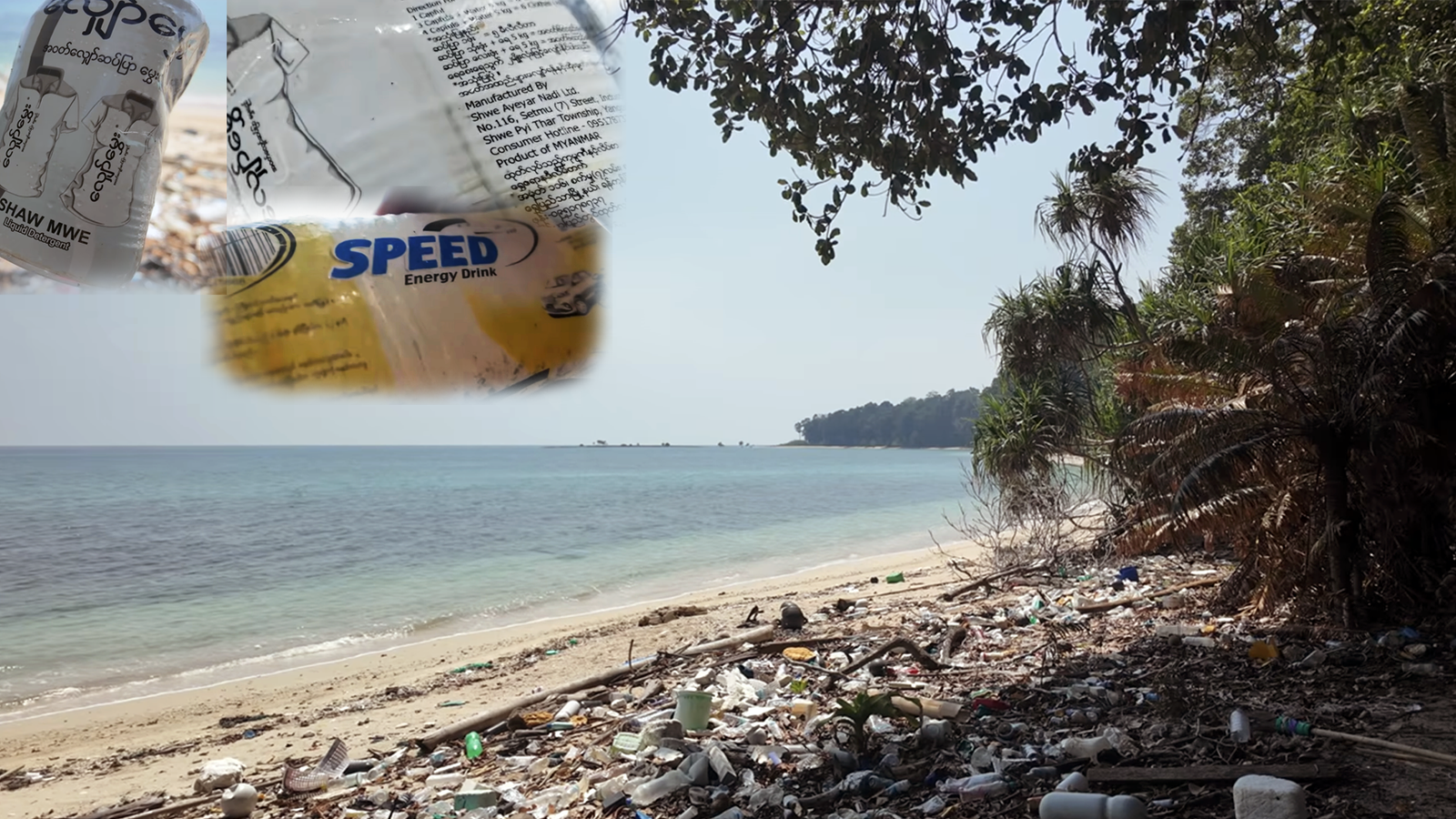
The pristine beaches of the Andaman and Nicobar Islands are widely known for their untouched beauty, coral reefs, and rare marine biodiversity. However, a disturbing environmental reality is emerging across several remote islands of the archipelago. Vast quantities of plastic waste originating from foreign countries are increasingly washing ashore, transforming once-clean coastlines into polluted dumping grounds.
Various Indian social media influencers and environmental activists have repeatedly highlighted this alarming situation through videos and ground reports to draw the attention of authorities and policymakers. Despite these efforts and widespread public concern, large quantities of plastic waste continue to appear on the beaches of the islands, raising serious questions about the scale of the problem and the urgency of international intervention.
In a recent video “Explorer Shibaji” shared the visual evidence from beaches in Little Andaman shows piles of discarded plastic bottles, packaging materials, fishing gear, and household waste carrying labels from neighboring Southeast Asian nations such as Myanmar, Thailand, and Malaysia. These findings highlight a growing phenomenon of transboundary marine pollution, where waste generated thousands of kilometers away ultimately contaminates India’s coastal ecosystems.
What is particularly alarming is that this pollution does not remain confined to urban beaches. Instead, remote and ecologically sensitive islands—home to rare species and fragile coral ecosystems—are increasingly bearing the burden of international plastic waste.
Ocean Currents Acting as Global Plastic Conveyors
One of the primary drivers of this crisis lies in the powerful ocean currents of the Bay of Bengal. These currents function like massive natural conveyor belts, transporting floating debris across international waters.
Large volumes of plastic waste enter the ocean through poorly managed coastal dumping and river systems across Southeast Asia. Rivers carrying urban waste eventually discharge plastics into the sea, where strong surface currents gradually push them westward toward the Andaman archipelago.
Environmental researchers estimate that over 11 million tonnes of plastic waste enter the oceans globally every year, and a significant portion originates from regions with limited waste management infrastructure. Studies of marine debris distribution indicate that the Bay of Bengal is one of the major accumulation zones for floating plastic pollution in the Indian Ocean region.
The Andaman Islands sit directly in the pathway of these currents, making them particularly vulnerable to incoming marine debris.
Shipping Traffic and Maritime Waste Dumping
Another critical factor contributing to plastic pollution around the islands is the archipelago’s strategic location near the Strait of Malacca.
The strait is one of the busiest maritime trade corridors in the world, with over 100,000 ships passing through it annually. These vessels connect the economies of East Asia, Southeast Asia, the Middle East, and Europe.
Due to this intense maritime activity, illegal dumping of ship-generated waste and discarded fishing gear frequently occurs in nearby waters. Plastics, packaging materials, nets, ropes, and containers thrown into the sea often drift with currents until they reach Indian territory.
Such practices are prohibited under international maritime laws such as the MARPOL Convention, yet enforcement remains inconsistent across many parts of the world.
Therefore, the plastic waste appearing on Andaman beaches could originate from two major sources:
- Land-based waste from Southeast Asian countries
- Direct dumping from international shipping vessels
This makes the issue not merely a domestic environmental concern but a complex transnational governance challenge.
Weak Waste Management Systems in the Region
Across parts of Southeast Asia, rapid urbanization and consumption have significantly increased plastic waste generation. However, many cities lack adequate waste processing infrastructure.
For example, large rivers such as the Mekong River transport massive quantities of plastic debris into the ocean. Scientific studies have identified several Asian rivers as among the top global contributors to marine plastic pollution.
When unmanaged plastic enters these rivers, it eventually flows into the sea and disperses across international waters. Over time, ocean currents redirect this waste toward remote coastlines—including the Andaman Islands.
This phenomenon illustrates how poor waste management in one region can create environmental consequences for another country thousands of kilometers away.
Serious Threats to Marine Biodiversity
The ecological consequences of plastic accumulation around the Andaman Islands are profound.
The region hosts some of India’s most sensitive marine ecosystems, including coral reefs, mangrove forests, and seagrass meadows. Plastic debris often settles on coral colonies, blocking sunlight and reducing oxygen flow, which can trigger coral bleaching and reef degradation.
Marine wildlife faces even greater risks.
Species such as the endangered Dugong and the critically endangered Leatherback Sea Turtle frequently mistake plastic debris for food. Ingested plastics can cause internal injuries, starvation, and eventually death.
Discarded fishing nets—commonly referred to as “ghost nets”—pose another deadly threat. These nets continue to trap fish, turtles, and dolphins long after being abandoned at sea.
Environmental monitoring reports suggest that marine plastic pollution has increased dramatically in Indian Ocean ecosystems over the past decade, raising concerns about long-term biodiversity loss.
Microplastic Contamination Entering the Food Chain
As plastics break down through sunlight, waves, and friction, they fragment into microplastics smaller than 5 millimeters.
These microscopic particles are easily consumed by plankton, fish, and shellfish. Over time, microplastics move up the marine food chain through a process called bioaccumulation.
Scientists warn that microplastic contamination has already been detected in seafood consumed by humans. This raises serious concerns about potential health risks, including exposure to toxic chemicals attached to plastic particles.
For communities living in the Andaman Islands—many of whom rely heavily on fisheries—this contamination represents a growing environmental and public health concern.
Economic Consequences for Tourism and Fisheries
The Andaman Islands’ economy depends significantly on eco-tourism and sustainable fishing. Tourists travel from across the world to experience the region’s pristine beaches, coral reefs, and marine wildlife.
However, plastic pollution directly undermines this reputation.
Beaches covered with foreign plastic debris damage the islands’ international image as an untouched tropical paradise. At the same time, fishermen face increasing losses due to damaged nets, contaminated catch, and declining marine resources.
According to environmental observers and reports cited by organizations like Mongabay-India and media outlets such as NDTV, the financial burden of cleaning beaches and protecting coastal ecosystems is steadily rising.
For small island communities, this creates long-term economic vulnerability.
Local Cleanup Efforts Provide Only Temporary Relief
Authorities and local organizations in areas like Great Nicobar regularly organize cleanup drives to remove plastic debris from beaches.
In some cases, collected plastic waste is shredded and repurposed for road construction projects. While these initiatives help reduce immediate environmental damage, they do not address the root cause of the problem.
The scale of incoming marine debris is simply too large for manual cleanup operations to manage permanently.
Without international cooperation, the inflow of plastic waste will continue indefinitely.
Why India Must Raise This Issue at International Forums
The plastic pollution affecting the Andaman Islands is not merely an environmental challenge—it is a cross-border geopolitical issue.
If waste originating from foreign nations or international ships continues to accumulate on Indian territory, the matter must be addressed at global platforms such as:
- United Nations Environment Programme (UNEP)
- International Maritime Organization (IMO)
- Regional maritime cooperation forums
India should push for joint monitoring mechanisms, stricter enforcement of maritime waste regulations, and regional waste management agreements with neighboring countries.
Investigating the precise origin of marine debris through scientific tracking, labeling analysis, and satellite monitoringcan help identify responsible sources.
Such evidence would strengthen India’s position in demanding accountability.
Treating Transboundary Plastic Pollution as a National Priority
If Indian waste were to accumulate on the shores of another nation, diplomatic consequences would likely follow. The same principle must apply when foreign-origin waste begins to damage India’s fragile island ecosystems.
The Andaman and Nicobar Islands are not only environmentally significant but also strategically important for India’s maritime security.
Therefore, protecting their ecological integrity must be considered a national priority.
Plastic waste drifting across oceans may appear harmless at first glance. But in reality, it represents a silent form of environmental invasion that threatens biodiversity, public health, and economic stability.
Addressing this crisis will require international cooperation, stronger maritime enforcement, and regional responsibility for waste management.
Until then, the beautiful beaches of the Andaman Islands will continue to remind the world of a troubling truth: plastic pollution respects no borders.
About The Author
Discover more from Jist Feed
Subscribe to get the latest posts sent to your email.