

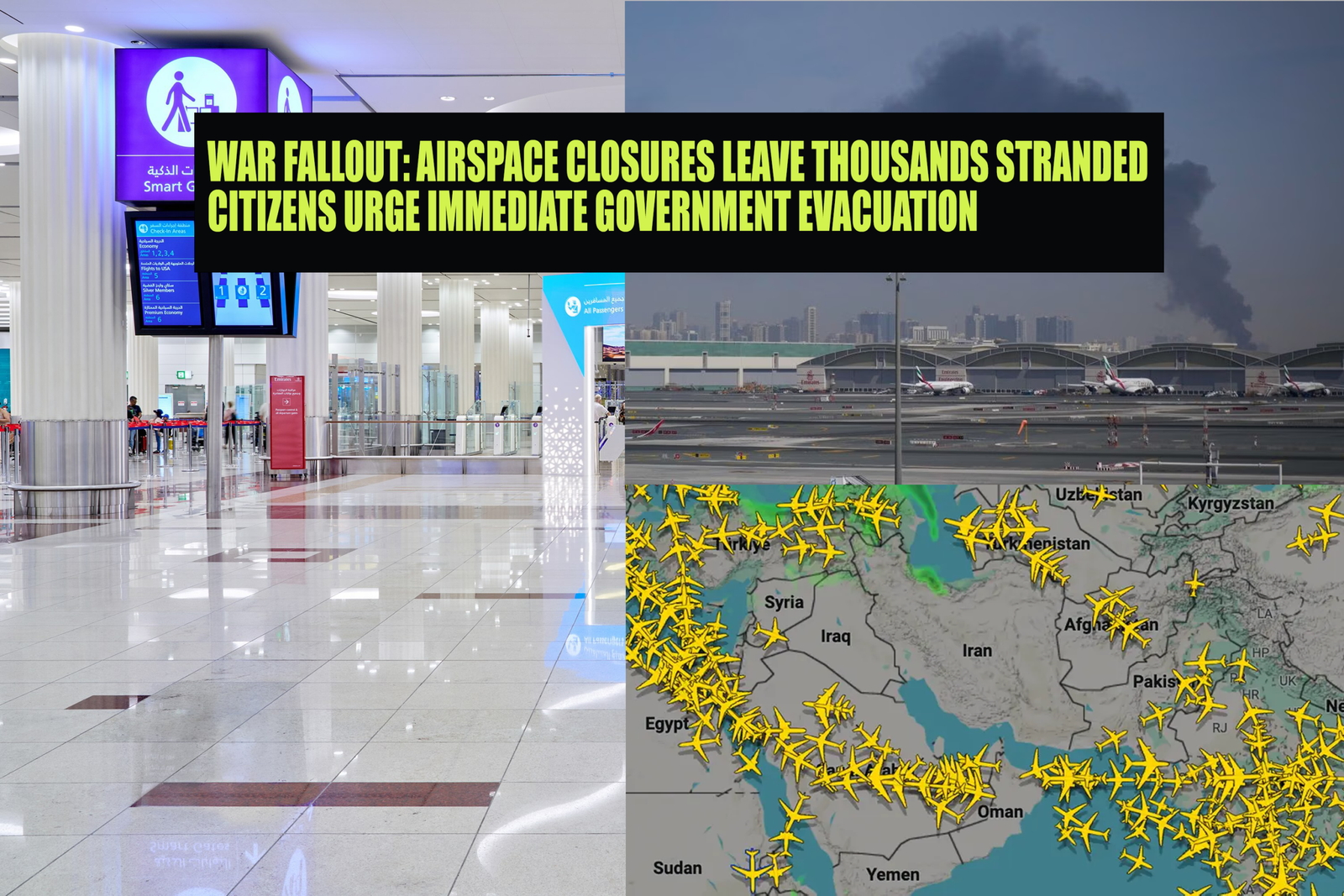
As military tensions intensify across West Asia following strikes by the United States and Israel on Iran, thousands of Indian nationals stranded in West Asia are facing uncertainty, flight cancellations, and prolonged delays. With airspace closures over Iran, Iraq, and key Gulf regions, major transit hubs such as Dubai, Abu Dhabi, and Doha have been severely affected.
Nearly 10 million Indians live and work across the Gulf region, making this one of the most serious overseas crises for the Indian diaspora in recent years.
War Fallout: Airspace Closures Leave Thousands Stranded
Following coordinated military strikes by the United States and Israel targeting sites in Iran, widespread airspace restrictions were imposed across:
- Iran
- Iraq
- Parts of the UAE
- Qatar
- Saudi Arabia
As a result, hundreds of flights from major Indian cities including Delhi and Mumbai have been cancelled or indefinitely postponed. Airlines have suspended services, leaving travelers—students, workers, families, and medical patients—stuck in transit hubs or conflict-sensitive zones.
Scheduled departures are being cancelled continuously, and uncertainty is growing as waiting periods stretch longer by the day.

Government Response:
The Indian government has described the situation as a “matter of grave concern.” Prime Minister Narendra Modi has held discussions with leaders from Israel and the UAE to assess the safety of Indian citizens and explore de-escalation pathways.
However, with flight disruptions worsening daily, stranded citizens are now urging immediate action before the crisis deepens.
State Governments Activate Emergency Support
Several Indian state governments have stepped in to assist their residents abroad:
- Karnataka – 24/7 control room operational
- Punjab – Dedicated helplines activated
- Telangana – Emergency tracking systems deployed
Families back home are anxiously awaiting updates, with many calling for a coordinated national evacuation plan similar to past rescue missions conducted during Gulf conflicts.
Airline Updates: Limited Resumption, Major Suspensions Continue
Airlines have issued travel advisories and flexible rebooking policies:
- Air India Express: Resuming Muscat flights from March 3, but services to Bahrain, Kuwait, Qatar, Saudi Arabia, and UAE remain suspended.
- IndiGo and Air India: Most Middle East services halted through March 2, offering full refunds and rescheduling.
Despite partial resumptions, uncertainty looms as security assessments change hourly.
Embassy Advisories: Leave Immediately if Possible
The Embassy of India in Tehran has urged Indian nationals in Iran to leave immediately using any available means. Meanwhile, advisories in Israel and the UAE recommend:
- Exercising utmost caution
- Avoiding non-essential travel
- Staying near designated shelters
- Maintaining contact with Indian missions
Citizens are encouraged to register on the MADAD portal for assistance.
Emergency Helplines for Indian Nationals
The Ministry of External Affairs has activated emergency contact channels:
- UAE (Embassy/Consulate): Toll-Free 800-46342
- Iran (Tehran): cons.tehran@mea.gov.in (24-hour hotlines operational)
- MADAD Portal: Online registration for evacuation support
Families are advised to keep passport details, visa copies, and contact information ready when reaching out.
Growing Public Demand: “Act Before It’s Too Late”
With the war situation intensifying rapidly and air corridors remaining unpredictable, stranded Indians across West Asia are demanding urgent evacuation measures.
Many fear:
- Further escalation in hostilities
- Prolonged airport shutdowns
- Fuel shortages and border closures
- Safety risks in conflict zones
Past evacuation missions have demonstrated India’s logistical strength and diplomatic capability. Citizens are now calling for similar swift, decisive action to prevent humanitarian distress.
What Should Stranded Citizens Do Now?
- Register immediately on the MADAD portal.
- Stay in constant contact with the nearest Indian mission.
- Avoid unnecessary movement in conflict-sensitive zones.
- Monitor official government and airline updates.
- Keep emergency documents and essential supplies ready.
As per 6:04 PM, update:
Dubai Airports confirms that a limited resumption of operations will begin later today, 2 March, with a small number of flights permitted to operate from Dubai International (DXB) and Dubai World Central – Al Maktoum International (DWC).
Zayed International Airport (AUH) has officially announced a partial resumption of flight operations. While there was a total suspension earlier in the weekend due to regional airspace closures, “exceptional flight operations” have now commenced to assist stranded passengers.
Conclusion: A Defining Moment for Diaspora Protection
The current crisis affecting Indian nationals stranded in West Asia is not just a travel disruption—it is a humanitarian and diplomatic test. With millions of Indians living across the Gulf region, timely intervention is critical.
As tensions escalate and uncertainty grows, the urgent appeal from citizens is clear:
Initiate large-scale evacuation at the earliest to safeguard Indian lives before the situation worsens.
The coming days will determine how swiftly relief reaches those waiting far from home.
About The Author
Discover more from Jist Feed
Subscribe to get the latest posts sent to your email.