

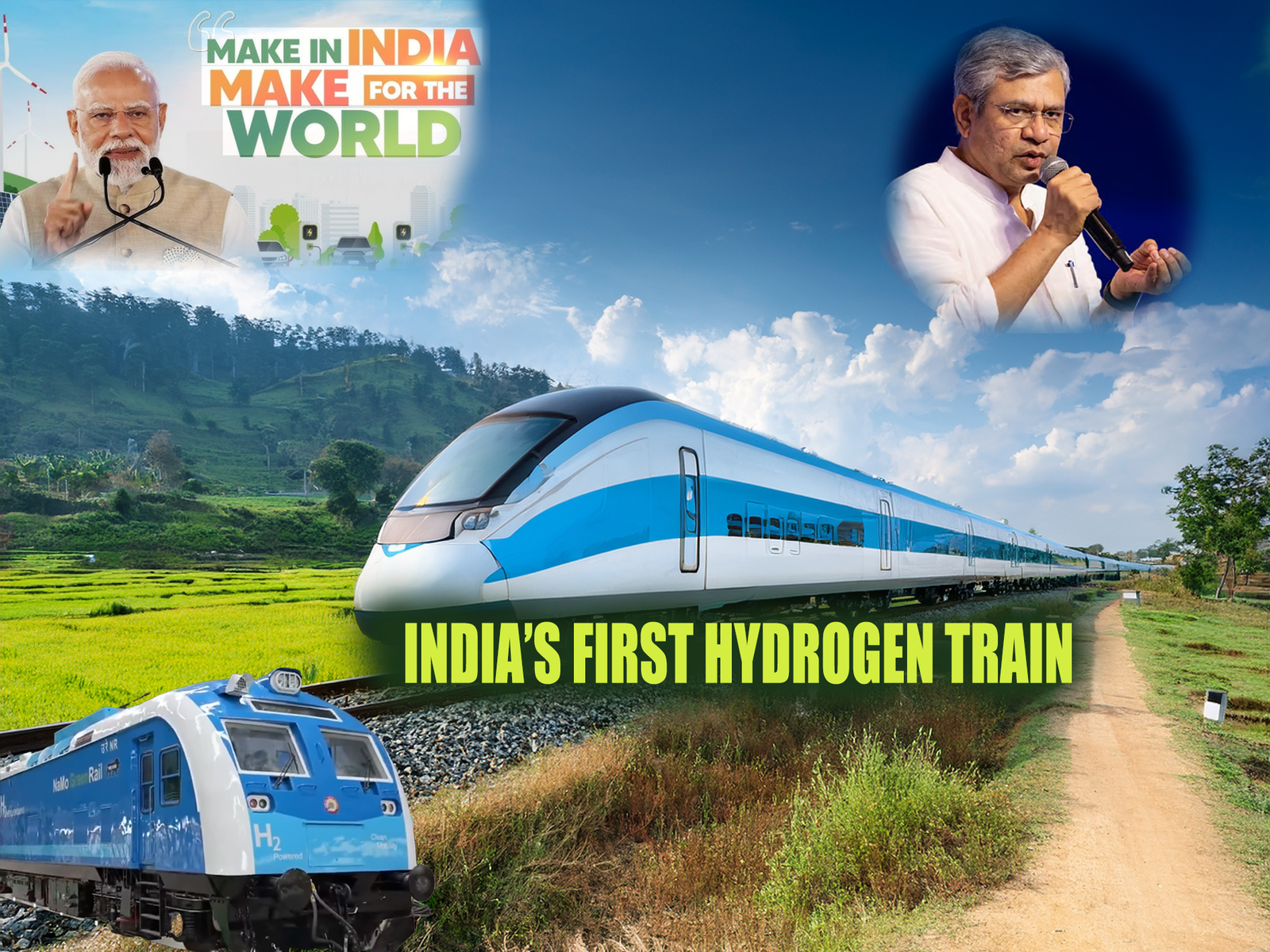
India Enters the Global Hydrogen Rail Elite
We are witnessing a historic transformation in Indian Railways as India’s first hydrogen-powered train trial has successfully commenced on the Jind–Sonipat route in Haryana in early 2026. This milestone positions India among a select group of advanced nations—Germany, Sweden, Japan, and China—that have operational hydrogen-powered rail technology. The pilot project is being executed by Northern Railway in collaboration with the Research Designs and Standards Organisation (RDSO), reflecting a decisive shift toward sustainable, future-ready transport solutions.
This breakthrough is not a symbolic demonstration. It is a full-scale, indigenously engineered hydrogen train-set designed for real-world passenger operations, marking a fundamental departure from diesel dependency on non-electrified routes.
Trial Timeline and Operational Highlights
Field Trials and Technical Validation
We note that field trials were widely reported to begin around January 26, 2026, following a series of successful preliminary tests earlier in the month. These included oscillation trials and Emergency Brake Distance (EBD) tests, both of which met stringent safety and performance benchmarks mandated by Indian Railways.
Pilot Corridor Details
- Route Length: 90 kilometres
- Section: Jind–Sonipat via Gohana
- Trial Speed Limit: 110 km/h
- Maximum Capable Speed: 140–150 km/h
- Estimated Travel Time: Approximately one hour
This corridor was strategically selected to validate hydrogen propulsion under Indian operating conditions, including frequent halts, high passenger density, and broad-gauge dynamics.
Expected Passenger Fare Structure
Although official fare notifications are awaited, media estimates suggest a highly affordable range between ₹5 and ₹25, reinforcing Indian Railways’ commitment to inclusive green mobility. This pricing model demonstrates that clean energy transport can remain accessible to the general public without cost escalation.
Indigenously Built Hydrogen Train: Technical Excellence
Manufactured in India
The hydrogen-powered train-set has been designed and manufactured at the Integral Coach Factory (ICF), Chennai, under the Make in India initiative. This achievement underscores India’s growing capability to develop complex, next-generation rail technologies domestically.
Train Configuration and Capacity
- Total Coaches: 10
- Driving Power Cars (DPCs): 2 (one at each end)
- Passenger Coaches: 8
- Total Passenger Capacity: Approximately 2,500–2,600 passengers
This configuration ensures operational flexibility, bi-directional movement, and optimal energy distribution across the rake.
Unprecedented Power Output
With a total power output of 2,400 kW (1,200 kW per power car), this train ranks among the most powerful hydrogen-powered train-sets globally operating on a broad-gauge platform. The power rating allows smooth acceleration, higher cruising speeds, and reliable performance even under peak load conditions.
Zero-Emission Fuel Cell Technology Explained
Electrochemical Energy Generation
The train employs advanced hydrogen fuel-cell technology, where hydrogen reacts with oxygen in an electrochemical process to generate electricity. Unlike combustion-based engines, this process produces only water vapour and steam as by-products, making it completely emission-free at the point of use.
Environmental Impact
- No carbon dioxide emissions
- No nitrogen oxides or particulate matter
- Near-silent operation compared to diesel trains
This technology directly supports India’s national commitments toward carbon neutrality and cleaner air, especially in environmentally sensitive corridors.
Jind Green Hydrogen Plant: Backbone of the Pilot Project
Dedicated Hydrogen Production Facility
To support uninterrupted operations, a dedicated green hydrogen production and refuelling plant has been established at Jind. This facility represents a critical integration of renewable energy with rail transport.
Production Capacity and Technology
- Electrolyzer Type: Polymer Electrolyte Membrane (PEM)
- Electrolyzer Capacity: 1 MW
- Daily Hydrogen Output: Approximately 430 kg
The hydrogen is produced using water and renewable electricity, ensuring the fuel remains genuinely green throughout the value chain.
Efficiency Metrics
- Water Requirement: ~9 kg of water to produce 900 grams of hydrogen
- Energy Utilisation: 900 grams of hydrogen can power the train for one kilometre
These efficiency figures demonstrate the viability of hydrogen propulsion for regional and intercity rail services.
Hydrogen Storage Capability
- On-site Storage Capacity: 3,000 kg of hydrogen
This buffer ensures operational reliability and accommodates daily service schedules without refuelling disruptions.
Hydrogen for Heritage Mission: The Road Ahead
Strategic National Expansion
The success of the Jind–Sonipat pilot is designed to catalyse the “Hydrogen for Heritage” mission. Under this initiative, Indian Railways plans to deploy 35 hydrogen-powered trains across eight identified heritage and hill routes where conventional electrification is technically challenging or environmentally intrusive.
Eight Planned Heritage and Hill Routes for Hydrogen Trains
1. Kalka–Shimla Railway (Himachal Pradesh)
A UNESCO World Heritage Site, this iconic mountain railway is expected to be the first heritage route with commercial hydrogen operations, preserving its fragile Himalayan ecosystem.
2. Darjeeling Himalayan Railway (West Bengal)
Another UNESCO-listed route where hydrogen will replace diesel traction, significantly reducing pollution in the Eastern Himalayas.
3. Nilgiri Mountain Railway (Tamil Nadu)
Famous for its rack-and-pinion system, this line is slated for a green transition without altering its historic engineering character.
4. Matheran Hill Railway (Maharashtra)
A popular narrow-gauge route near Mumbai, serving an eco-sensitive, vehicle-free hill station.
5. Kangra Valley Railway (Himachal Pradesh)
A scenic corridor planned for hydrogen-powered Vande Metro-style trains, combining heritage preservation with modern comfort.
6. Bilimora–Waghai Line (Gujarat)
A historic narrow-gauge railway through dense forests and tribal regions.
7. Patalpani–Kalakund Section, Mhow (Madhya Pradesh)
Known for its tunnels and waterfalls, this route benefits from silent, emission-free traction.
8. Goram Ghat (Rajasthan)
A picturesque stretch through the Aravalli hills, ideal for sustainable tourism-driven rail services.
Project Investment and Infrastructure Commitment
Cost Structure
- Cost per Hydrogen Train: Approximately ₹80 crore
- Ground Infrastructure per Route: Around ₹70 crore
These investments cover hydrogen production units, storage systems, refuelling stations, and safety infrastructure.
Route-Specific Infrastructure Example
For the Kalka–Shimla route, three hydrogen storage and refuelling stations are planned at:
- Kalka
- Barog
- Shimla
This decentralised approach ensures operational continuity across mountainous terrain.
Why India’s Hydrogen Train Matters Globally
We see this initiative as a strategic leap in rail innovation, combining indigenous manufacturing, renewable energy integration, and environmental stewardship. The India hydrogen-powered train is not merely an alternative to diesel—it is a scalable blueprint for decarbonising rail networks across the developing world.
By aligning advanced technology with affordability and heritage preservation, Indian Railways is setting a global benchmark for sustainable mass transport.
About The Author
Discover more from Jist Feed
Subscribe to get the latest posts sent to your email.