

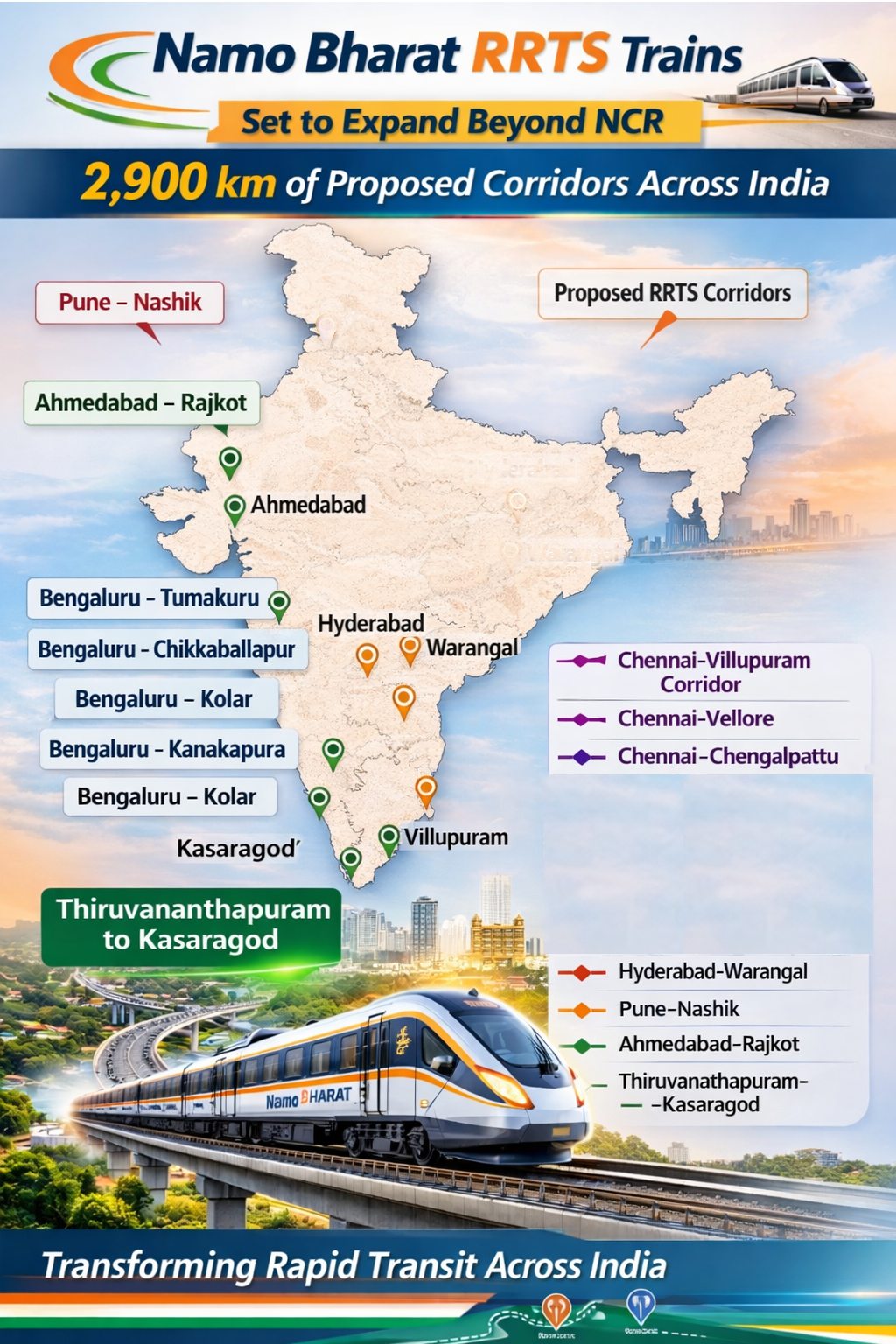
India’s regional mobility landscape is set for a transformative shift as the Namo Bharat RRTS Expansion in Indiagathers momentum beyond the National Capital Region (NCR). After the successful rollout of the Namo Bharat corridors in Delhi-NCR, multiple states have expressed strong interest in replicating the Regional Rapid Transit System (RRTS) model to enhance connectivity, boost economic infrastructure, and improve ease of living.
According to the Economic Survey 2025–26, nearly 2,900 km of potential RRTS corridors have been identified nationwide. This ambitious expansion signals a major leap in India’s semi-high-speed regional rail ecosystem, bridging metropolitan hubs with tier-2 and tier-3 cities.
What is Namo Bharat RRTS?
The National Capital Region Transport Corporation (NCRTC) introduced the Namo Bharat branding for India’s Regional Rapid Transit System. Designed for speeds up to 160–180 kmph, RRTS aims to reduce travel time between urban clusters while maintaining affordability and high-frequency services.
Following operational success in NCR corridors such as Delhi–Meerut, the model is now being viewed as a template for other high-density regional clusters across India.
Southern Region: Major Push for RRTS Corridors
Tamil Nadu: Chennai-Centric Expansion
Tamil Nadu is emerging as a frontrunner in adopting the Namo Bharat RRTS framework.
Chennai–Villupuram Corridor
A final feasibility study has recommended the Alandur–Villupuram alignment, positioning it as a transformative infrastructure project worth approximately ₹75,000 crore. The corridor aims to reduce travel time from nearly four hours to just one hour.
Key hubs to be connected include:
- Tambaram
- Chengalpattu
- Tindivanam
- Villupuram
The proposed alignment strengthens Chennai’s suburban and regional integration, supporting industrial and residential expansion.
Other Proposed Routes
Feasibility studies are also underway for:
- Chennai–Vellore
- Chennai–Chengalpattu
If approved, these corridors will significantly decongest urban Chennai while enhancing intercity accessibility.
Karnataka: Bengaluru’s Semi-High-Speed Network
The Karnataka government has proposed five major RRTS-style corridors radiating from Bengaluru:
- Bengaluru–Mysuru
- Bengaluru–Tumakuru
- Bengaluru–Chikkaballapur
- Bengaluru–Kolar
- Bengaluru–Kanakapura
With an estimated investment requirement of ₹1.5 lakh crore, the state is actively seeking central government funding.
As India’s IT capital, Bengaluru faces severe traffic congestion and suburban sprawl. A Namo Bharat-type system would reduce daily commute times, enhance workforce mobility, and unlock satellite town development.
Telangana: Hyderabad–Warangal Rapid Link
The Economic Survey 2025–26 flagged a proposed corridor between Hyderabad and Warangal.
Planned Features:
- Speed: 160–180 kmph
- Travel time target: Under 1 hour
- Focus: Regional integration and industrial growth
The corridor aims to boost economic activity between the capital and emerging industrial centers, creating a stronger regional economic belt.
Kerala: SilverLine and RRTS Vision
Kerala has given in-principle approval to the ambitious SilverLine project.
Key Highlights:
- Length: 583 km
- Route: Thiruvananthapuram to Kasaragod
- Structure: Primarily elevated to minimize land acquisition
- Status: Approved in principle (January 2026)
The project seeks to transform north-south connectivity in Kerala, reducing travel time across the state while minimizing environmental and displacement concerns.
Western & Central India: Strategic Regional Links
Maharashtra: Pune–Nashik Semi-High-Speed Corridor
Land acquisition is currently active for a 235 km link between Pune and Nashik.
Objectives:
- Dual-use for passenger and logistics
- Strengthening industrial connectivity
- Supporting freight movement
This corridor is expected to enhance Maharashtra’s manufacturing and export capacity by connecting major industrial nodes.
Gujarat: Ahmedabad–Rajkot Link
A 227 km semi-high-speed corridor between Ahmedabad and Rajkot has been proposed and is awaiting central approval.
Gujarat’s industrial growth corridors make this link strategically important, particularly for textile, automotive, and SME clusters.
National High-Speed Rail Integration
The Union Budget 2026 also announced complementary High-Speed Rail (HSR) projects designed for speeds exceeding 300 kmph. These include:
- Mumbai–Pune
- Pune–Hyderabad
- Chennai–Bengaluru
These HSR routes will integrate with regional RRTS networks, creating a multi-layered rail ecosystem—local metro, regional rapid rail, and national bullet train corridors.
This tiered integration ensures:
- Seamless last-mile connectivity
- Reduced dependency on highways
- Balanced regional economic development
Why States Are Embracing the RRTS Model
The growing interest in Namo Bharat RRTS expansion is driven by several factors:
1. Decongestion of Mega Cities
Major cities like Chennai, Bengaluru, and Hyderabad face chronic traffic bottlenecks. RRTS offers high-capacity, fast, and reliable alternatives.
2. Boost to Regional Economies
Improved connectivity stimulates:
- Industrial growth
- Real estate expansion
- Job creation
- Logistics efficiency
3. Ease of Living
Shorter commute times enhance quality of life and reduce stress for daily commuters.
4. Sustainable Transport
Electrified rapid rail reduces carbon emissions compared to private vehicles and road transport.
2,900 Km Vision: A National Mobility Revolution
The identification of approximately 2,900 km of corridors signals a structural shift in India’s infrastructure planning. Unlike traditional railway upgrades, RRTS systems are purpose-built for semi-high-speed regional travel with:
- Dedicated tracks
- Advanced signalling systems
- Modern rolling stock
- High-frequency operations
The Namo Bharat model has demonstrated operational efficiency, passenger comfort, and urban transformation potential. Replicating this system nationwide could redefine intercity travel within 100–250 km ranges.
Challenges Ahead
While the vision is ambitious, key challenges remain:
- High capital costs
- Land acquisition hurdles
- Environmental clearances
- Centre–state funding coordination
However, the successful NCR implementation provides a template for financial structuring, engineering design, and public-private partnerships.
The Namo Bharat RRTS Expansion in India marks a new chapter in the country’s transportation history. With 2,900 km of corridors under consideration, southern, western, and central states are aligning themselves with a high-speed regional future.
From Chennai to Bengaluru, Hyderabad to Thiruvananthapuram, and Pune to Ahmedabad, India is laying the groundwork for a seamless, multi-tiered rail network that promises faster travel, economic growth, and improved quality of life.
If implemented as envisioned, the RRTS expansion could become one of the most significant infrastructure transformations of the decade—reshaping how Indians live, work, and commute across regions.
About The Author
Discover more from Jist Feed
Subscribe to get the latest posts sent to your email.