

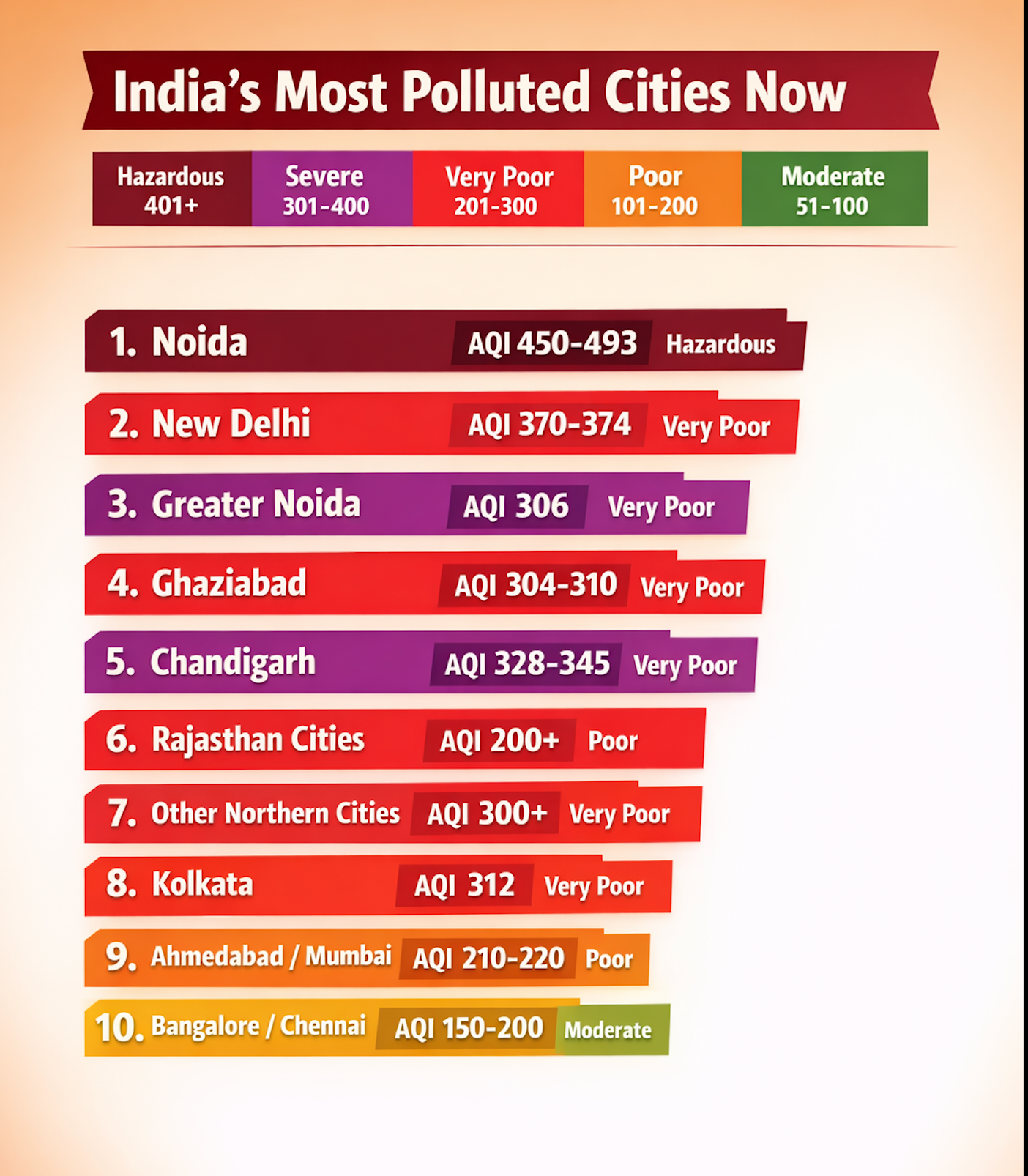
New Delhi is recording one of the worst Air Quality Index (AQI) levels in the entire country, with hazardous pollution choking the National Capital and its neighbouring regions. According to the latest live AQI data, several Indian cities are in the hazardous bracket.
As of the most recent real-time data available on December 18, 2025, the these cities are showing the highest Air Quality Index (AQI), pushing them into the hazardous category.
Why These Cities Experience Such High AQI Levels
1. Meteorological Conditions
Pollutants are trapped near the ground by the winter inversion layer in northern India. Dispersal is inhibited by low wind speeds, cool temperatures, and stable atmospheric conditions. This “pollution bowl” effect affects cities in the Indo-Gangetic Plain, including New Delhi and its satellite towns.
2. Vehicular Emissions
Rapid urbanisation has significantly increased vehicle numbers, many of which run on older, more polluting engines. Traffic congestion in cities like New Delhi, Noida, and Faridabad contributes substantially to PM2.5 and NOx emissions.
3. Industrial Pollution
Industrial clusters around cities like Kapurthala, Faridabad, and Gorakhpur emit particulate matter and toxic gases. Weak enforcement of emission standards exacerbates the problem.
4. Construction Dust
Ongoing construction activities without adequate dust control measures introduce large amounts of PM10 into the air, adding to existing pollution burdens.
5. Biomass Burning & Agricultural Fires
Crop residue burning in neighbouring states of Punjab and Haryana adds massive quantities of PM2.5 into the atmosphere, especially during harvest seasons. These pollutants drift into urban centres, compounding local sources.
About The Author
Discover more from Jist Feed
Subscribe to get the latest posts sent to your email.