

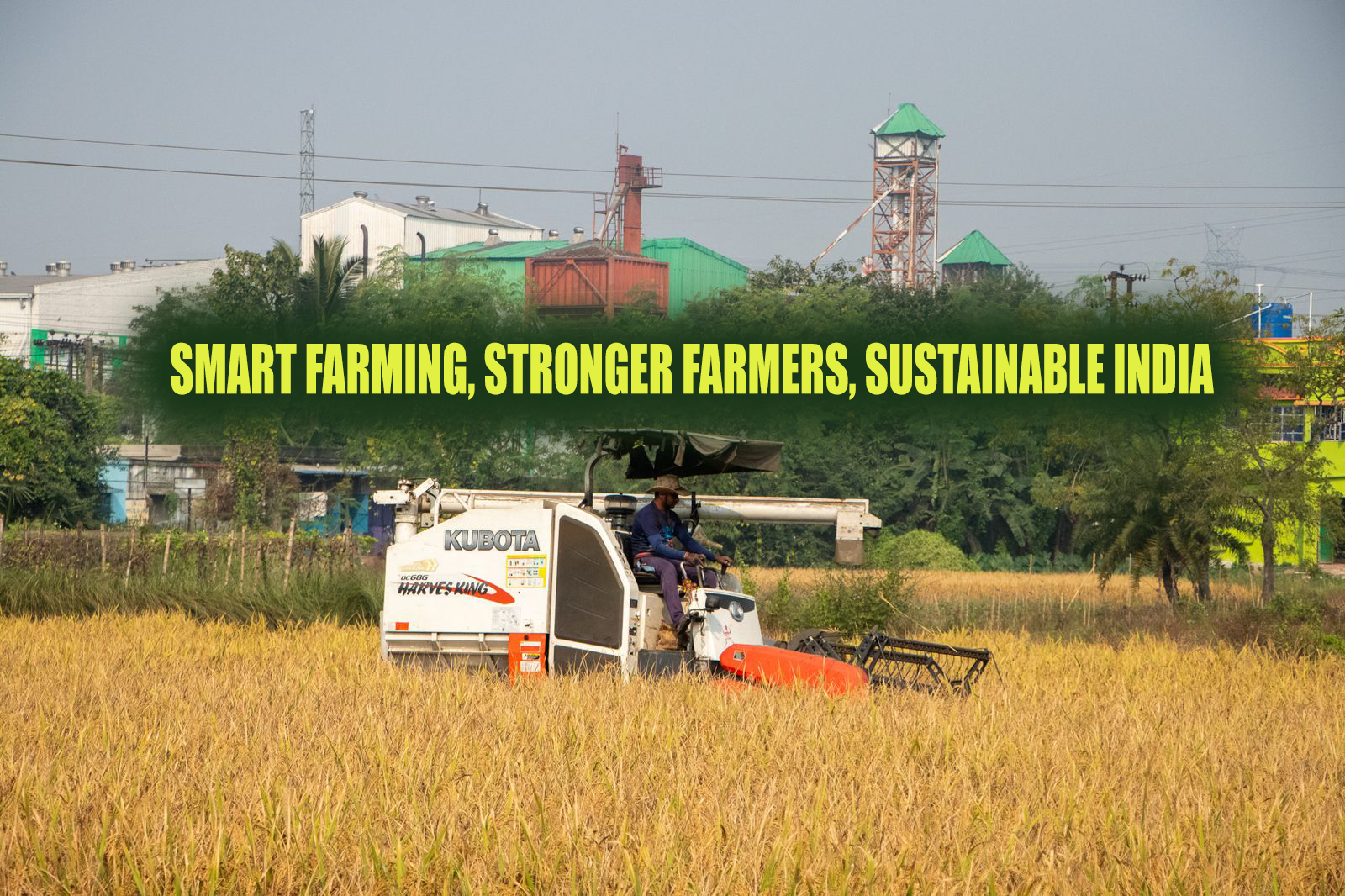
India needs another Agricultural Revolution
The Green Revolution once transformed the nation from food scarcity to self-sufficiency. Today, with a population exceeding 147 crore, climate volatility intensifying, and global food demand rising, the country requires a second, technology-driven agricultural revolution. This transformation is being powered by new farming techniques and digital services, strategically implemented by the Government of India to enhance farmer income, climate resilience, productivity, and global competitiveness.
By shifting away from harmful chemical pesticides and embracing intelligent farming techniques supported by digital services, agriculture can achieve higher yields while ensuring long-term environmental and economic sustainability.
The latest initiatives announced by the Minister of State for Agriculture and Farmers Welfare, Shri Ramnath Thakur in a written reply in Lok Sabha which indicate a clear vision: make India food-independent, technologically empowered, and a global supply hub for agricultural products. Through sustainable farming practices, mechanization, insurance coverage, and a robust Digital Public Infrastructure (DPI) for Agriculture, the nation is redefining how food is grown, managed, insured, and marketed.
Sustainable Agriculture Under National Mission for Sustainable Agriculture (NMSA)
At the core of this transformation lies the National Mission for Sustainable Agriculture (NMSA), which promotes farming systems that are productive, resource-efficient, and climate-resilient.
Per Drop More Crop (PDMC): Maximizing Water Efficiency
The Per Drop More Crop (PDMC) scheme has revolutionized irrigation by encouraging micro-irrigation technologies such as drip and sprinkler systems. These technologies significantly reduce water wastage while increasing crop yields. With shrinking groundwater levels and erratic rainfall, PDMC ensures optimal water use at the farm level, directly contributing to sustainability and cost reduction for farmers.
Rainfed Area Development: Integrated Farming Systems
Rainfed regions are particularly vulnerable to climate uncertainty. The Rainfed Area Development program promotes Integrated Farming Systems (IFS), combining crops, livestock, fisheries, and agroforestry. This diversification minimizes risk, stabilizes income, and enhances productivity even under adverse climatic conditions.
Soil Health & Fertility Scheme: Restoring the Foundation
Healthy soil is the backbone of agriculture. The Soil Health & Fertility Scheme emphasizes integrated nutrient management, encouraging balanced use of chemical fertilizers along with organic inputs. Through soil testing and scientific advisory, farmers are empowered to improve yields while preserving long-term soil health.
Horticulture, Agroforestry, and Bamboo: Building Climate Resilience
The Mission for Integrated Development of Horticulture (MIDH), Agroforestry initiatives, and the National Bamboo Mission collectively strengthen climate resilience. These programs promote high-value crops, diversified land use, carbon sequestration, and alternative income streams, making agriculture more profitable and environmentally sustainable.
Comprehensive Crop Insurance for Risk Mitigation
Agriculture faces increasing risks from extreme weather events. To safeguard farmers, the government has implemented robust insurance mechanisms.
Pradhan Mantri Fasal Bima Yojana (PMFBY)
PMFBY provides comprehensive insurance coverage against crop failure due to natural calamities, pests, and diseases. It ensures timely financial support, reducing distress and encouraging continued investment in farming.
Restructured Weather Based Crop Insurance Scheme
Complementing PMFBY, this weather index-based insurance protects farmers from adverse weather deviations, ensuring risk coverage even when yield losses are weather-driven.
Sub Mission on Agricultural Mechanization (SMAM): Powering Farms with Technology
Mechanization is critical to improving efficiency and reducing drudgery. The Sub Mission on Agricultural Mechanization (SMAM), implemented since 2014–15 and now under Rashtriya Krishi Vikas Yojana (RKVY), focuses on “reaching the unreached.”
Key Achievements of SMAM
- ₹9,404.47 crore released as central funds
- 21.6 lakh+ agricultural machines distributed on subsidy
- 27,554 Custom Hiring Centers (CHCs) established
- 646 Hi-Tech Hubs and 25,608 Farm Machinery Banks (FMBs) created
These interventions have increased farm power availability from 1.73 kW/ha in 2013–14 to 2.49 kW/ha in 2018–19, significantly boosting operational efficiency, especially for small, marginal, and women farmers.
Prime Minister Dhan Dhaanya Krishi Yojana (DDKY): A Convergent Growth Model
Announced in Union Budget 2025–26 and launched on 11 October 2025, the Prime Minister Dhan Dhaanya Krishi Yojana (DDKY) represents a holistic approach to agricultural development.
Key Objectives of DDKY
- Enhance agricultural productivity
- Promote crop diversification and sustainable practices
- Strengthen post-harvest storage at panchayat and block levels
- Improve irrigation infrastructure
- Facilitate long-term and short-term credit availability
Implemented across 100 districts, DDKY converges 36 existing schemes across 11 departments, state programs, and private-sector partnerships, creating an integrated and scalable model for rural transformation.
Digital Agriculture Mission: Building a National Agri Digital Backbone
The future of Indian agriculture is digital. Under the Digital Agriculture Mission, the government is building a Digital Public Infrastructure (DPI) that ensures transparency, efficiency, and innovation.
AgriStack: A Single Source of Truth
AgriStack integrates three foundational registries:
- Geo-Referenced Village Maps
- Crop Sown Registry
- Farmers Registry
This system establishes a unique Farmer ID, enabling seamless integration with Direct Benefit Transfer (DBT)schemes such as PM-Kisan, PMFBY, MSP procurement, credit access, input distribution, and disaster relief. As of 4 February 2026, over 8.48 crore Farmer IDs have been generated nationwide.
Digital Crop Survey and Krishi Decision Support System
Digital Crop Survey
The Digital Crop Survey provides plot-level visibility of crops, enabling accurate estimation of sowing patterns. This data-driven approach improves planning for procurement, logistics, and input supply.
Krishi Decision Support System (KDSS)
The KDSS is a powerful geo-spatial GIS platform integrating satellite imagery, weather, soil, and crop data. It supports evidence-based agricultural planning and delivers targeted advisories to farmers, extension workers, and policymakers.
AI-Powered Farmer Services: From Advisory to Pest Control
Kisan e-Mitra: Voice-Based AI Support
Kisan e-Mitra is an AI-powered, voice-based chatbot supporting 11 regional languages. It assists farmers with PM-Kisan queries and is expanding to other schemes. Currently handling 8,000+ queries daily, it has answered over 95 lakh farmer queries, improving accessibility and trust.
National Pest Surveillance System (NPSS)
The NPSS leverages Artificial Intelligence and Machine Learning to detect pest infestations through image-based diagnostics. Used by 10,000+ extension workers, it supports 65 crops and over 400 pests, enabling timely intervention and reducing crop losses.
SATHI and National Seed Grid: Ensuring Seed Integrity
The Seed Authenticity Traceability & Holistic Inventory (SATHI) platform streamlines seed production, certification, distribution, and traceability across India. By establishing a National Seed Grid (NSG), it integrates all seed stakeholders into a unified digital ecosystem, ensuring quality, transparency, and availability.
How This Policy Can Actually Help a Marginal Farmer
1. Lower Risk, Not Just Higher Production
For a marginal farmer, the biggest fear is loss, not low yield.
- PM Fasal Bima Yojana + Weather-Based Insurance reduces the fear of total ruin due to drought, floods, or unseasonal rain.
- Even partial compensation helps a farmer avoid debt traps with moneylenders.
» This doesn’t make farmers rich, but it keeps them in farming.
2. Mechanization Without Owning Machines
A marginal farmer cannot buy tractors or harvesters — and this is where Custom Hiring Centres (CHCs) matter.
- Farmers can rent machines at subsidized rates
- No upfront capital
- Faster operations → timely sowing & harvesting → better yields
» This is one of the most practical benefits, if CHCs are accessible and well-managed.
3. Water Efficiency = Survival
Schemes like Per Drop More Crop directly address water scarcity.
- Drip irrigation reduces water use by 30–50%
- Fertilizer costs fall because nutrients are applied precisely
- Crop failure risk drops in dry regions
» For small landholders, saving water equals saving the farm.
4. Digital Farmer ID: Quiet but Powerful
At first glance, AgriStack & Farmer ID sound abstract. In reality:
- Faster PM-Kisan payments
- Easier crop insurance claims
- Improved access to credit
- Reduced corruption & duplication
»This is a long-term enabler, not an instant benefit — but it matters.
5. AI Tools Help Where Extension Workers Don’t Reach
Marginal farmers often never see an agriculture officer.
- Kisan e-Mitra answers scheme-related doubts in local languages
- National Pest Surveillance System helps identify pest attacks early
» These tools don’t replace human help — but they fill a real gap.
What a Marginal Farmer Should Do First to Actually Benefit from These Policies
Coming down to the reality, let’s put clear, practical light on what a marginal farmer should actually do first, step by step, in real life, not in theory
1. Secure Identity Before Anything Else (Most Important Step)
Everything starts with being visible to the system.
A marginal farmer should first ensure:
- Farmer ID is created under AgriStack
- Land records are updated and linked (even jointly owned land)
Why this matters:
- Without Farmer ID → no PM-Kisan, no insurance, no DBT
- Faster compensation during crop loss
- Easier access to schemes without repeated paperwork
» Action point:
Visit the nearest Common Service Centre (CSC) or agriculture office and ask specifically for Farmer Registry / Farmer ID enrollment.
2. Enroll in Crop Insurance Every Season (Non-Negotiable)
Many marginal farmers skip insurance to save premium money — this is a costly mistake.
What to do:
- Enroll in PM Fasal Bima Yojana every cropping season
- Ensure crop and plot details are accurately recorded during Digital Crop Survey
Why:
- One failed crop can wipe out years of effort
- Insurance keeps farmers out of moneylender debt
» Action point:
Check enrollment status through CSC, bank branch, or agriculture department before sowing.
3. Use Custom Hiring Centres Instead of Buying Machines
Never buy expensive machinery.
Instead:
- Identify the nearest Custom Hiring Centre (CHC)
- Use subsidized rental for:
-
- Seed drills
- Sprayers
- Harvesters
Benefits:
- Lower costs
- Timely farm operations
- Better yields
» Action point:
Ask the Block Agriculture Office or FPO about CHCs in your area.
4. Shift to Water-Efficient Farming Immediately
Water decides survival.
What to prioritize:
- Drip or sprinkler irrigation under Per Drop More Crop
- Mulching and micro-irrigation for vegetables and horticulture crops
Why:
- Saves water
- Reduces fertilizer cost
- Improves consistency of yield
» Action point:
Apply through state agriculture portal or local office for micro-irrigation subsidy.
5. Get Soil Tested and Follow Soil Health Card Advice
Many marginal farmers overuse fertilizer.
Correct approach:
- Get soil tested
- Follow Soil Health Card recommendations
Why:
- Lower input cost
- Healthier soil
- Stable long-term productivity
» Action point:
Submit soil sample through agriculture extension worker or KVK.
6. Diversify Crops, Don’t Bet Everything on One Crop
Single-crop dependency is dangerous.
Better strategy:
- Combine food crop + horticulture / pulses / fodder
- Integrate livestock or poultry if possible
Why:
- Income spreads across seasons
- Reduced climate risk
- Better cash flow
» Action point:
Seek guidance under Rainfed Area Development or local KVK.
7. Use Digital Help, Even if You’re Not Tech-Savvy
Technology doesn’t require expertise — just access.
Useful tools:
- Kisan e-Mitra (voice-based, local language)
- Pest image capture through extension workers (NPSS)
Why:
- Faster answers
- Early pest control
- Reduced crop loss
» Action point:
Save the Kisan e-Mitra number or ask CSC for assistance.
8. Join or Form an FPO (Farmer Producer Organization)
Alone, a marginal farmer has no bargaining power.
Through FPOs:
- Cheaper inputs
- Better market prices
- Easier access to credit and storage
Why:
- Collective strength reduces exploitation
- Government schemes favor organized farmers
» Action point:
Contact NABARD office, KVK, or local agriculture department.
What a Marginal Farmer Should Not Do
❌ Don’t take high-interest private loans
❌ Don’t ignore insurance
❌ Don’t buy machinery on credit
❌ Don’t depend only on one crop
The Reality Check (Very Important)
These policies will not transform income overnight.
What they will do:
- Reduce losses
- Stabilize income
- Lower risk
- Gradually improve profitability
For a marginal farmer, stability is the first victory.
Conclusion: Towards Food Independence and Global Leadership
We believe that new farming techniques and digital services are not incremental reforms—they represent a structural transformation of Indian agriculture. By combining sustainability, mechanization, insurance, and digital intelligence, India is preparing for a future where agriculture is resilient, profitable, data-driven, and globally competitive.
However, Let’s be honest — good policy does not automatically mean good outcomes. If marginal farmers secure identity, manage risk, reduce costs, and act collectively, these policies can genuinely work.
As the nation once led the Green Revolution, it is now poised to lead a Digital and Sustainable Agriculture Revolution, ensuring quality food for every citizen and positioning India as a global agricultural supply hub in the decades ahead. Instead of relying on harmful chemical pesticides, higher and more sustainable yields can be achieved through the adoption of advanced, intelligent farming techniques and digital services, which play a critical role in improving productivity while protecting soil, crops, and human health.
About The Author
Discover more from Jist Feed
Subscribe to get the latest posts sent to your email.