

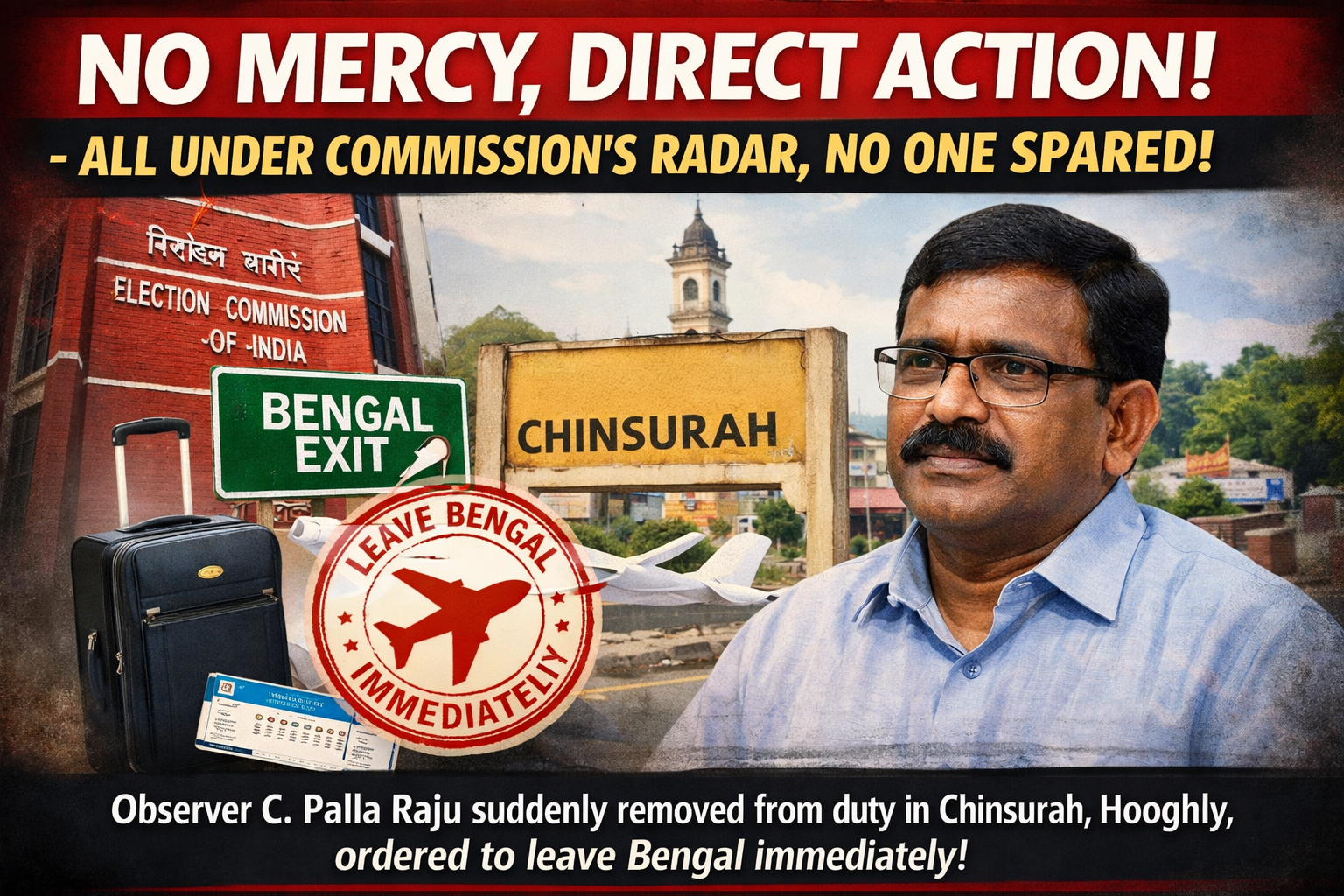

What we are witnessing in West Bengal right now is not routine—it’s unprecedented. In recent memory, has any state in India seen an Election Commission act this fast, this tough, and this uncompromising? The answer is simple: no. This time, the Commission has made one thing absolutely clear—it will not tolerate fear, bias, or manipulation. A free and fair election is not just a promise; it’s being enforced.
From the era of T.N. Seshan and the standards he set, to where things stand today, officials like Gyanesh Kumar and Manoj Agarwal are pushing that legacy forward with renewed aggression. The scale itself is staggering—152 constituencies under watch, 40,000 state police personnel deployed, and over 2,000 companies of central forces taking charge of the ground reality. On top of that, real-time, minute-by-minute monitoring is being carried out at the national level. This is not just administration—it’s a full-scale operation.
A striking incident unfolded in Hooghly’s Chinsurah. Observer C. Pallraju—an IAS officer reportedly from Himachal Pradesh—was abruptly removed. Not just removed, but ordered to leave West Bengal immediately. No adjustments, no second chances, no quiet transfers. The message was blunt: step out of line, and you’re out—instantly.
Sources suggest possible links or influence involving political consultancy networks like I-PAC, raising serious questions about internal compromise. Whether proven or not, the Commission didn’t wait. It acted. And that speed itself is the statement.
Another observer, Rajesh Kumar Sharma, was immediately given additional responsibility for the constituency. Work didn’t stop for a second. Replacement was swift, seamless, and decisive.
This isn’t just about removing one officer. It’s about setting a precedent. The Election Commission is signaling that even its own appointed officials are not beyond scrutiny. Bias, negligence, or hidden alignments—none will be spared.
Meanwhile, Chief Electoral Officer Manoj Agarwal held a high-level virtual meeting with all officers-in-charge across 152 constituencies, along with district SPs, special observers, and senior officials. The directive was crystal clear: any violation of the Model Code of Conduct, any hint of bias, any suspicious behavior—and you will face immediate suspension. No delays, no excuses.
For the first time, officers are being made to feel that the system is watching them as closely as they are supposed to watch the election.
What’s even more significant is the Commission’s focus on monitoring political influence networks. Dedicated teams in Delhi are tracking reports across multiple levels. Intelligence units have been activated. Data is being analyzed continuously. The idea is simple—identify manipulation before it spreads.
The days of quiet “adjustments” seem to be under attack.
For years, sections of the administrative machinery—IAS, IPS, WBCS, police—have been accused of becoming part of a compromised system. Whether that perception is fully accurate or not, this time the Election Commission is challenging it head-on. And the removal of Pallraju is not just an action—it’s a warning.
So far, reports suggest no major violence or fatalities in the initial phases. That itself is a shift in Bengal’s electoral history. If this momentum continues through all phases, and holds strong till counting day, it could mark a turning point.
This election is no longer just about votes. It’s about whether the system can finally break its own patterns.
And right now, the message is loud and unmistakable: no one is untouchable.
About The Author
Discover more from Jist Feed
Subscribe to get the latest posts sent to your email.