

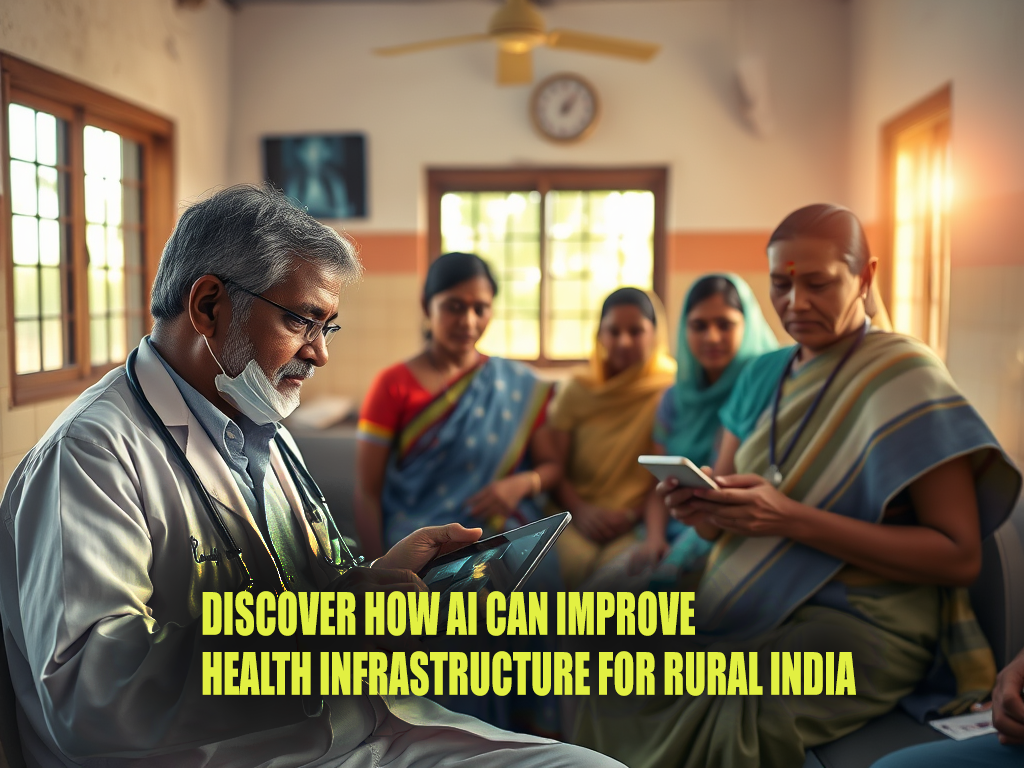
India’s healthcare system is undergoing a significant transformation as artificial intelligence (AI) moves from a futuristic concept to a practical, life-saving tool. With nearly 65% of India’s population living in rural areas and a doctor-patient ratio that often exceeds 1:11,000 in many regions, the need for scalable, technology-driven solutions is urgent.
The question is no longer whether AI will impact healthcare — it is how AI can improve health infrastructure to rural Indian people in a sustainable and inclusive way.
From early disease detection to telemedicine, operational efficiency, and drug discovery, AI is steadily strengthening India’s healthcare backbone — especially in underserved rural communities.
1. Early Disease Detection and Diagnostics in Rural India
One of the most powerful ways AI can improve health infrastructure in rural India is through early and accurate disease detection.
AI in Tuberculosis Screening
India carries one of the world’s highest tuberculosis burdens. AI-powered tools like Cough Against TB are being used for community-level screening. These tools analyze cough sounds using machine learning algorithms and have demonstrated a 12–16% higher yield in case reporting compared to traditional screening methods ( source Ministry of Health and Family Welfare ).
Early detection means:
- Faster treatment
- Reduced transmission
- Lower mortality rates in rural communities
AI for Cancer and Eye Disease Detection
Indian health-tech startups such as Qure.ai and NIRAMAI are revolutionizing diagnostics.
- Qure.ai uses AI to analyze chest X-rays to detect TB and lung abnormalities within minutes.
- NIRAMAI leverages thermal imaging and AI algorithms for early breast cancer detection without radiation.
Additionally, Microsoft has partnered with Indian hospitals to develop AI models that predict the progression of diabetic retinopathy, preventing avoidable blindness — a major issue in rural diabetic populations.
AI in Maternal Health
Maternal and neonatal mortality remain concerns in rural India. Researchers have developed Garbhini-GA2, an AI model that predicts fetal age with an error margin of just half a day — significantly outperforming conventional methods.
Accurate fetal age prediction helps:
- Prevent premature deliveries
- Improve antenatal monitoring
- Reduce maternal health risks
By bringing advanced diagnostics to remote Primary Health Centres (PHCs), AI eliminates the need for patients to travel long distances for specialist consultations.
2. Telemedicine and Remote Care: Bridging the Rural-Urban Divide
Telemedicine is perhaps the most visible example of how AI can improve health infrastructure to rural Indian people.
eSanjeevani: Digital Healthcare at Scale
The government’s eSanjeevani platform has facilitated over 350 million consultations, connecting rural patients with doctors in urban centers.
AI supports this ecosystem by:
- Assisting doctors with differential diagnoses
- Prioritizing urgent cases
- Analyzing patient history for faster consultations
For rural patients, this means:
- Reduced travel costs
- Faster access to specialists
- Continuous medical follow-ups
AI-Powered Rural Clinics
States like Uttar Pradesh have launched AI-enabled rural clinics that analyze:
- X-rays
- Blood reports
- Genetic data
These clinics allow local health workers to collect data, which AI systems process and forward to specialists for interpretation. This model significantly reduces dependency on urban hospitals.
In regions where specialist doctors are scarce, AI acts as a “digital assistant,” enhancing the capabilities of frontline healthcare workers.
3. Operational Efficiency: Supporting Overburdened Rural Doctors
Another crucial aspect of how AI can improve health infrastructure to rural Indian people lies in operational efficiency.
India’s rural healthcare system struggles with limited manpower and heavy administrative workloads.
Automation of Administrative Tasks
Generative AI agents are increasingly used for:
- Patient inquiries
- Appointment scheduling
- Digital record-keeping
- Clinical documentation
By automating repetitive tasks, healthcare staff can focus more on patient care rather than paperwork.
Fraud Detection Under Ayushman Bharat
Under Ayushman Bharat, AI tools are deployed to:
- Detect fraudulent insurance claims
- Identify unnecessary procedures
- Optimize treatment pathways
Fraud prevention ensures that government funds are used effectively, strengthening healthcare delivery in rural districts.
4. AI in Drug Discovery and Clinical Research
India’s pharmaceutical sector is also embracing AI to reduce drug development costs and accelerate research.
Companies like:
- Sun Pharma
- Dr. Reddy’s Laboratories
are using AI to identify potential drug molecules faster and at lower costs.
AI helps:
- Reduce drug development time by up to 60%
- Identify suitable candidates for clinical trials
- Target high-burden diseases like diabetes and TB
For rural India, this means:
- More affordable medicines
- Faster access to innovative treatments
- Improved public health outcomes
India is positioning itself as a global hub for affordable, AI-driven medical innovation.
5. Government Initiatives Strengthening AI Infrastructure
The Indian government is building the digital backbone required for AI-driven healthcare transformation.
Ayushman Bharat Digital Mission (ABDM)
The Ayushman Bharat Digital Mission aims to digitize over 500 million patient records.
This creates:
- A unified health ID system
- Interoperable medical records
- A massive dataset for AI-based predictive analytics
With digital records in place, AI can:
- Detect disease trends early
- Predict outbreak patterns
- Recommend preventive care strategies
Centres of Excellence for AI
Premier institutions such as:
- AIIMS Delhi
- PGIMER Chandigarh
- AIIMS Rishikesh
have been designated as Centres of Excellence for AI in healthcare.
These institutions are fostering indigenous AI solutions tailored to India’s unique rural health challenges.
Challenges That Must Be Addressed
While AI offers immense promise, certain challenges remain:
- Limited internet connectivity in remote villages
- Data privacy concerns
- Need for digital literacy among healthcare workers
- Infrastructure gaps in PHCs
For AI to truly improve health infrastructure to rural Indian people, investments must continue in digital infrastructure, training programs, and cyber security.
The Road Ahead: A Healthier Rural India Powered by AI
Artificial intelligence is no longer a luxury for urban hospitals — it is becoming a necessity for rural healthcare survival.
By enabling early diagnosis, supporting telemedicine, reducing administrative burdens, accelerating drug discovery, and strengthening digital health infrastructure, AI is reshaping the future of healthcare delivery in India.
If implemented responsibly and inclusively, AI can:
- Reduce rural mortality rates
- Improve maternal and child health
- Lower healthcare costs
- Strengthen preventive care systems
- Ensure equitable access to quality healthcare
The transformation is already underway. The coming decade will determine how effectively India leverages AI to build a resilient, accessible, and affordable rural healthcare infrastructure.
About The Author
Discover more from Jist Feed
Subscribe to get the latest posts sent to your email.