

West Bengal Researcher ‘s Survey Charts New Ground as Volatile Brent Crude Pushes India’s Oil Import Dependence to Nearly 89%
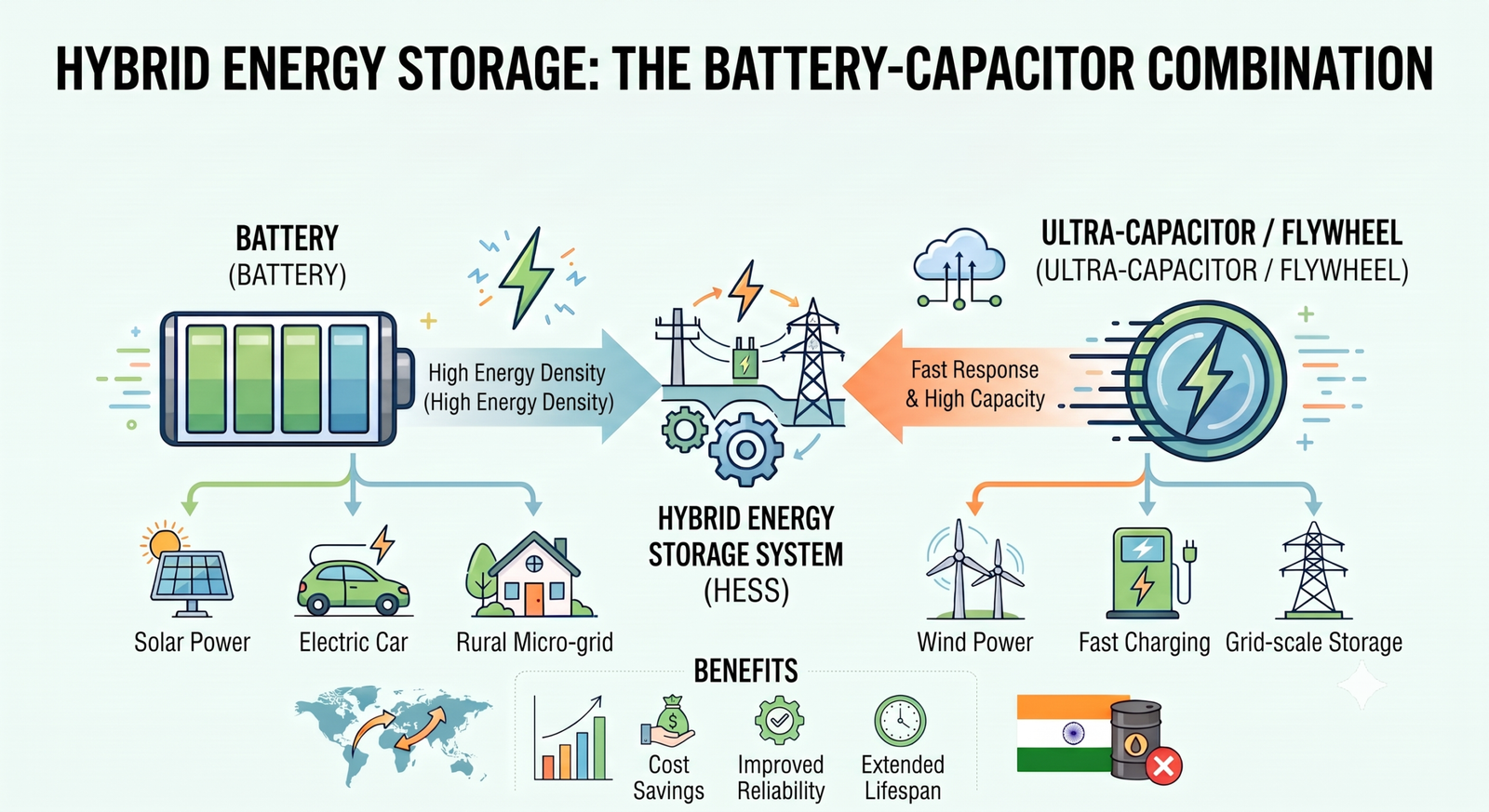
Kolkata: From solar and wind power to electric vehicles and rural micro-grids, the rapid expansion of renewable energy worldwide is driving up demand for reliable energy storage. Against this backdrop, Hybrid Energy Storage Systems (HESS), which combine two or more storage technologies, such as batteries, ultra-capacitors, flywheels or Superconducting Magnetic Energy Storage (SMES) are gaining ground. A survey paper recently published internationally by West Bengal researcher Dr Surajit Chattopadhyay and his team takes a detailed look at these technologies. At the same time, this year’s volatility in Brent crude prices, driven by conflict in West Asia, has sharpened the case for energy storage and green alternatives for import-dependent economies like India.
Background: Hybrid Models Fill the Gaps Left by Standalone Technologies
Batteries have long been the most familiar name in energy storage. Lithium-ion technology has pushed battery energy density up sharply, making batteries hard to beat for sustained power delivery. But batteries show clear limits when it comes to sudden, large power demands or frequent rapid charge-discharge cycles, repeated heavy use shortens their lifespan, and their response is comparatively slow.
Ultra-capacitors, flywheels and SMES, on the other hand, can deliver large bursts of power within milliseconds and withstand millions of charge-discharge cycles, but their energy density is far lower. The core idea behind hybrid energy storage is to combine these complementary strengths, so that a single system delivers both high energy and high power.
Where Exactly Is the Problem?
One of renewable energy’s biggest challenges is its unpredictability, solar output drops on cloudy days, wind output drops when the wind doesn’t blow. Managing that variability on the grid, powering fast EV charging, or keeping power supply uninterrupted on remote micro-grids all require a storage system that can hold energy over long periods and still deliver a large burst of power instantly when needed. No single technology can easily meet all three requirements, cost, reliability and lifespan , at once. Hybrid systems are an attempt to close that gap.
Present Scenario: A Fast-Growing Market
The global hybrid energy storage market is expanding rapidly. According to a recent review by The Business Research Company, the market was worth around $16.95 billion in 2025 and is projected to grow to roughly $18.4 billion in 2026 , an annual growth rate of about 8.5%. The report attributes this growth mainly to the spread of renewable energy, grid infrastructure constraints, government incentives, and advances in battery and capacitor technology.
India’s picture is equally encouraging. At India Energy Storage Week 2026 in New Delhi in July, Union Minister of State for Power and New & Renewable Energy Shripad Yesso Naik said the country’s Battery Energy Storage System (BESS) capacity currently stands at about 7.5 GWh, with roughly 140 GWh more under construction. Earlier, in March, a joint white paper by the India Energy Storage Alliance (IESA) and Customized Energy Solutions, unveiled at the SESI 2026 conference in Delhi’s Yashobhoomi, projected that India’s cumulative battery storage capacity could reach around 346 GWh by 2033. The government points to steps such as the 50 GWh Advanced Chemistry Cell (ACC) Production Linked Incentive scheme, Viability Gap Funding for standalone BESS projects, and the formal recognition of storage under the Electricity (Amendment) Rules 2025 as drivers of this growth.
It is against this larger backdrop that a survey paper has recently been published on the IASTDL research platform by West Bengal researcher Dr Surajit Chattopadhyay and his fellow researchers. Dr Chattopadhyay is an Associate Professor in the Department of Electrical Engineering at the Ghani Khan Choudhury Institute of Engineering and Technology (GKCIET), Malda, and has long worked on power systems, power quality and micro-grids. Their paper reviews the various hybrid energy storage technologies, how they perform, and the strategies used to integrate them. Combining batteries with fast-response devices such as capacitors or flywheels, the paper argues, improves reliability, extends system lifespan and lowers overall costs.
Table 1: Comparing the Major Energy Storage Technologies
| Technology | Energy Density (Wh/kg) | Power Density (W/kg) | Response Time | Approximate Cycle Life | Typical Use |
|---|---|---|---|---|---|
| Lithium-ion battery | 150 – 250 | 300 – 1,500 | Milliseconds -seconds | 500 – 6,000 | EVs, grid storage, homes |
| Ultra-capacitor | 5 – 15 | ~10,000 | Within milliseconds | 500,000+ | Fast power bursts, regenerative braking |
| Flywheel | 10 – 30 | 1,000 – 5,000 | Within milliseconds | Effectively unlimited | Frequency regulation, UPS |
| SMES | 1- 10 | Extremely high | Under a millisecond | Effectively unlimited | Grid stability, power quality |
(Figures above are representative ranges typical of each technology; actual values vary by specific design and chemistry.)
Fossil Fuel Dependence and the Brent Crude Worry
The turbulence in the Brent crude market over the past few months has sharpened questions of energy security. Brent held fairly steady in the $65–72 a barrel range through January- February 2026, but conflict in West Asia and supply disruption through the Strait of Hormuz sent it surging to nearly $120 a barrel in late February and March – a roughly 63% jump in a single month, the biggest monthly rise since 1988, according to market analysts. Prices eased somewhat between April and July, before renewed US-Iran tensions and strikes on Russian energy infrastructure pushed Brent back up to around $95 a barrel by mid-August a weekly gain of more than 7%.
For a country like India, this volatility carries a heavy price tag. According to Petroleum Planning and Analysis Cell (PPAC) data, imports accounted for 88.5% of India’s total crude oil consumption in July this year. That same month, India’s crude import bill stood at roughly $13.7 billion, up 41% from a year earlier, driven by both higher import volumes and higher prices. Crude oil accounts for roughly a fifth of India’s total merchandise import bill. As a result, a spike in Brent prices feeds directly into the rupee’s exchange rate, the country’s foreign exchange reserves, and overall inflation.
Table 2: Key Figures at a Glance
| Indicator | Value |
|---|---|
| Global hybrid energy storage market (2026) | ~$18.4 billion (8.5% annual growth) |
| India’s crude oil import dependence (July 2026) | 88.5% |
| India’s crude oil import bill (July 2026) | ~$13.7 billion (up 41% year-on-year) |
| Brent crude’s 2026 peak (March) | ~$120/barrel |
| India’s current battery storage capacity (mid-2026) | ~7.5 GWh (140 GWh more under construction) |
| India’s 2033 target | ~346 GWh of battery storage (IESA-CES) |
Why the Shift to Green Energy Matters
In this context, hybrid energy storage matters strategically as much as technically. Naik, in his address, noted that battery storage systems are no longer just backup for power outages, they are becoming an essential part of keeping the grid flexible, from absorbing surplus renewable power and regulating frequency to easing peak-hour strain and deferring transmission investment. Hybrid systems help perform these functions more efficiently, since they can guarantee both long-duration storage and instantaneous power delivery at once.
Over the long run, cutting import dependence in the energy sector is not just a climate goal, it is a matter of national economic security. The stronger the pairing of renewable sources with the right storage technology, the smaller the domestic economy’s exposure to swings in global markets like Brent crude.
Expert Analysis
According to Debmalya Sen, President of the India Energy Storage Alliance (IESA), India’s energy storage sector now stands at an inflection point, the tendering phase is giving way to execution, and the real challenge ahead will be securing financing for projects with lower tariffs. Industry observers note that announcing projects is not enough; delivering them on schedule is now the real test.
Technical hurdles remain too. India still assembles batteries domestically but imports most cells, mainly from China, so despite initiatives like the 50 GWh Advanced Chemistry Cell scheme, building a genuinely self-sufficient supply chain will take time. Manufacturing costs for technologies such as ultra-capacitors and flywheels also remain relatively high, though researchers expect these to fall steadily over the coming decade. Experts consider proper coordination between the Battery Management System (BMS), Power Conversion System (PCS) and Energy Management System (EMS) the biggest technical challenge in building hybrid systems, and this is largely the integration strategy that Dr Chattopadhyay and his co-researchers’ recent survey paper addresses as well.
Amidst the growing demand for Electric Vehicles (EVs) and renewable energy, a major revolution has occurred in supercapacitor manufacturing in India. While heavily dependent on foreign imports until now, these high-power energy storage devices are currently being produced through domestic initiatives. With technical assistance from ISRO, Kerala’s Keltron has recently started India’s first commercial supercapacitor production. Their factory is manufacturing around 36,000 units daily. The private sector is not lagging behind either. Hyderabad-based company ‘GODI India’ has manufactured a 3000F high-power supercapacitor using completely indigenous technology, which could be a game-changer for the EV industry. What are the current market prices? A glance at retail markets and online platforms shows significant price variations based on capacity. Low-capacity supercapacitors (like 3.3 μF or 10F) used for small projects or memory backup are available for just ₹100 to ₹300. On the other hand, high-capacity models (like 500F) used for large energy storage start around ₹1,200 to ₹2,500. Meanwhile, industrial-grade mega modules can cost ₹30,000 or more, depending on their capacity. According to experts, if domestic production continues to grow at this pace, super-capacitor prices will decrease further in the future, opening new horizons for their use alongside batteries in the electric vehicle market.
Taken together, hybrid energy storage is not a single magic solution, but a practical route to making energy systems more reliable and cost-effective by combining the complementary strengths of multiple technologies. The rapid growth of the global market and India’s policy push both point to this technology becoming one of the most important pillars of the energy sector over the next decade. But as long as uncertainty persists in global markets like Brent crude, the case for investing in and researching such storage technologies will only keep growing — especially for an import-dependent economy like India.
Sources: Petroleum Planning and Analysis Cell (PPAC); joint white paper by the India Energy Storage Alliance (IESA) and Customized Energy Solutions, March 2026; The Business Research Company, Hybrid Energy Storage Global Market Report 2026; Brent crude price data from the U.S. Energy Information Administration (EIA) and Trading Economics; Union Ministry of Power; survey paper by Dr Surajit Chattopadhyay and co-researchers, IASTDL, Vol. 1, Issue 2.
About The Author
Discover more from Jist Feed
Subscribe to get the latest posts sent to your email.