

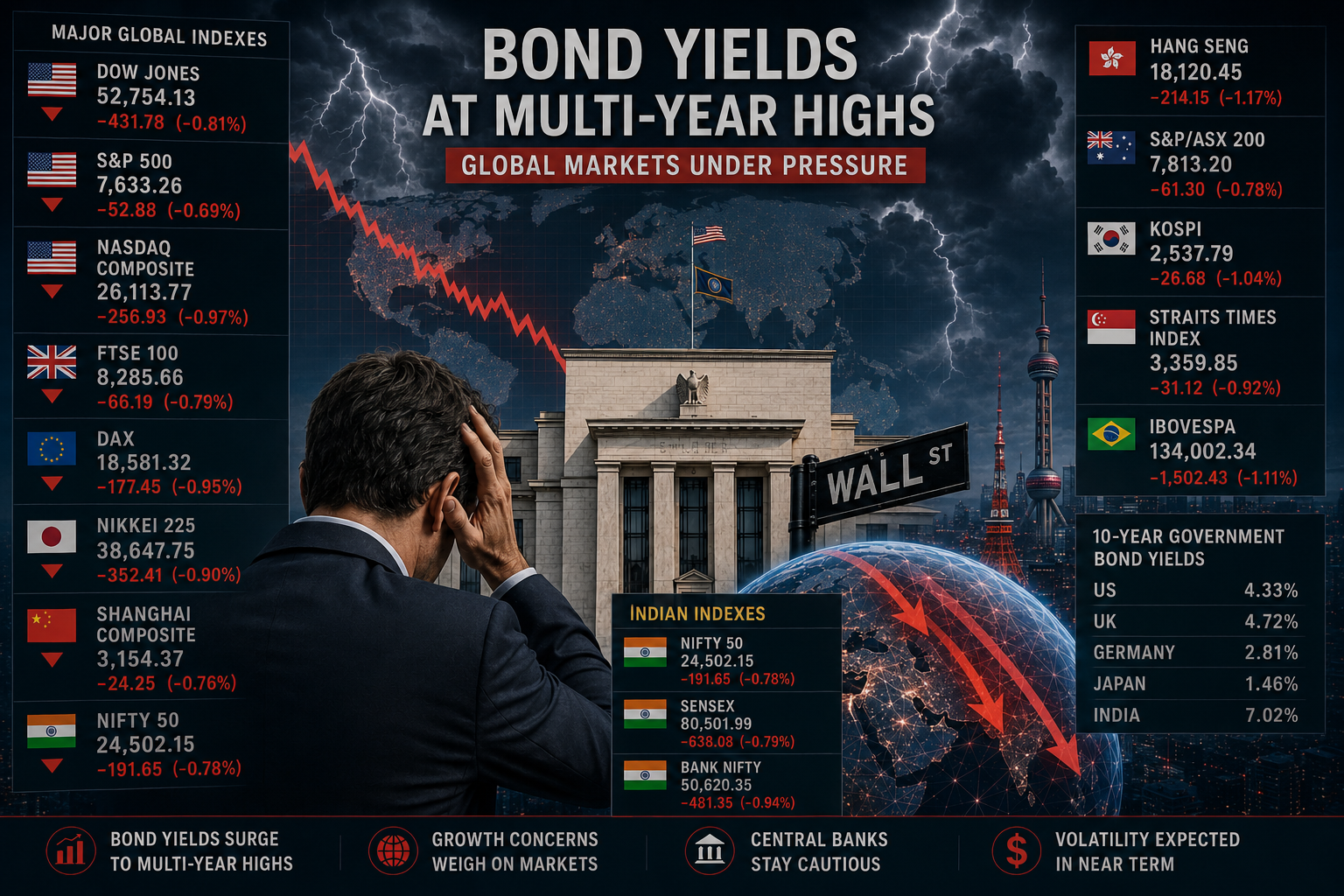
Global bond markets have entered September with what Reuters itself is calling a “September storm” a synchronised, worldwide bond sell-off that has pushed government borrowing costs from Washington to Tokyo to their highest levels in years, dragging stock markets lower along the way. Here is a plain-language breakdown of what’s happening, why it’s happening, and how long it could last.
KOLKATA, September 2: US stocks fell sharply on Tuesday, September 1, the first trading session of the month , as a renewed spike in government bond yields around the world rattled investor confidence. The sell-off has been building since US Federal Reserve Chair Kevin Warsh’s Jackson Hole speech on Friday, August 28, and shows little sign of fading as the week begins.
What Happened: The Selloff in Numbers
- The Dow Jones Industrial Average dropped 431.78 points, or 0.81%, to close at 52,754.13
- The S&P 500 slid 52.88 points, or 0.69%, to 7,633.26
- The Nasdaq Composite, dragged down by chip and AI-linked stocks, fell 256.93 points, or 0.97%, to 26,113.77
The damage was not confined to Wall Street. Asian and European markets traded mixed to lower through the week, as the bond rout went global.
Why Are Bond Yields Rising? Five Key Reasons
- A surprisingly hawkish Fed Chief. Delivering his first Jackson Hole address as Fed Chair, Kevin Warsh reaffirmed the Fed’s 2% inflation target and called July’s inflation reading (3.7% on the Fed’s preferred PCE gauge) concerning. He signalled the central bank still has work to do and did not rule out a rate hike, a notable shift, since markets had widely expected a Trump-appointed Fed chief to lean toward cutting rates instead. The odds of a 25-basis-point hike at the Fed’s September 16 meeting jumped to roughly 57 – 61%, up from about 35% before the speech.
- “Bond vigilantes” and fiscal worries. With governments across major economies running large deficits, bond investors are demanding higher compensation (yield) to keep lending to them , a dynamic market veterans call the return of the “bond vigilantes.”
- A renewed Iran conflict and surging oil prices. Fighting between the US and Iran escalated again over the weekend of August 29 – 30, with US forces striking Iranian targets. Oil prices jumped in response, with Brent crude climbing above $95 a barrel, reviving fears that costlier energy will keep inflation elevated for longer.
- Japan’s own bond troubles. Japan’s 10-year government bond yield hit 3% on Tuesday, its highest since 1996, as a weak yen and import-driven inflation fuel expectations that the Bank of Japan will raise rates this month. This matters globally: if Japanese investors keep more money at home rather than buying foreign bonds, it removes a major source of demand for US Treasuries and other overseas debt.
- Europe’s fiscal and political calendar. A difficult budget season and upcoming elections in parts of Europe are adding to bond-market nervousness there, reinforcing the synchronised, worldwide nature of this sell-off.
The Global Picture: 10-Year Bond Yields (September 1, 2026)
| Country | 10-Year Bond Yield | Context |
|---|---|---|
| United States | ~4.80% | Highest since January 2025; briefly touched 4.81% intraday |
| United Kingdom | ~5.22–5.25% | Highest since June 2008 |
| France | ~4.21% | Highest since 2008 |
| Germany | ~3.34% | Highest since 2011 |
| Japan | 3.00% | Highest since 1996 |
| India | ~6.98% | Modest rise; far more stable than developed markets |
A Bloomberg index tracking global government bonds rose to a yield of 3.72% – the highest since mid-2008, at the depths of the global financial crisis.
Bonds vs Stocks: Why a Yield Spike Hits Share Prices – Explained Simply
Think of a government bond the way you’d think of a bank fixed deposit (FD). If your bank suddenly offered a much higher, guaranteed FD rate, some money that might otherwise have gone into riskier stocks would shift into that safer, higher-paying FD instead. Rising bond yields do something similar on a global scale: as “risk-free” government bonds start paying more, they compete harder for investor money, drawing some of it out of the stock market.
There is a second, more technical effect. A stock’s price is, in theory, the value today of all the profit a company is expected to earn in the future. When yields rise, that future money is “discounted” more heavily, worth less in today’s terms. This hits high-growth, high-valuation stocks hardest, which is exactly why technology and AI-linked names Nvidia, AMD, Intel and Broadcom among them , have led the recent declines. Much of the AI data-centre boom is being financed with borrowed money, so higher interest rates directly raise the cost of that expansion. Adding to the unease, some analysts have flagged that not all of Big Tech’s AI spending commitments are fully visible on company balance sheets, raising questions about how resilient the sector would be if AI demand growth were to disappoint.
What Reuters Is Saying: Expert Analysis
Reuters’ flagship markets newsletter, Morning Bid, described the opening days of September as a “September storm.” Editor-at-large Mike Dolan noted that while much attention has gone to the 30-year bond, it is actually the 10-year yield that matters most for ordinary households, since it feeds directly into mortgage rates and the cost of business and consumer loans.
A separate Morning Bid column framed the moment through the lens of “bond vigilantes” policing government borrowing, warning that Japan’s own bond troubles could weaken a traditional pillar of demand for global debt markets just as fiscal deficits widen in both the US and Europe.
Beyond Reuters, Wall Street strategists are broadly cautious but not alarmed:
- Ross Mayfield, Baird Investment Strategist, expects markets to keep struggling with sharp bond-market swings for the foreseeable future, a near-term and longer-term feature of this environment, not a one-off event.
- Edward Jones Research expects the 10-year yield to stay within a 4.5%–5.0% range through the rest of the year and does not believe the move will derail the broader case for equities, citing still-strong corporate earnings growth. It does flag that a rapid push to the top of that range could pressure sentiment further.
- BlackRock Investment Institute views higher-for-longer yields as structural, part of a “global bond reset” underway since 2021, driven by persistent inflation, heavy government borrowing and AI-related investment demand, yet remains constructive on equities, particularly stocks tied to AI infrastructure.
- Deutsche Bank now expects the Fed to deliver a full percentage point’s worth of hikes this year in two steps, September and December, if the hawkish tone from Jackson Hole is followed through.
How Is India Affected?
India’s markets have so far proven far more resilient than Wall Street. On September 1, the BSE Sensex closed almost flat, down just 12.99 points (0.02%) at 76,944.28, while the Nifty 50 slipped 24.60 points (0.10%) to 24,055.80 a far smaller move than the roughly 1% declines seen in the US. Strong domestic GDP data helped cushion the blow.
Even so, the underlying pressure is visible: pharmaceutical, banking, auto and realty stocks fell, while IT and FMCG shares gained as investors rotated into more defensive sectors. India’s own 10-year government bond yield edged up to about 6.98%. Higher global crude prices are a particular concern for India, a major oil importer, since they threaten to widen the trade deficit and add to inflation and fuel costs for ordinary consumers.
How Long Will This Continue? What to Watch Next
There is no single date on which this story ends, but a few concrete events will shape the next phase:
- September 15–16: the Federal Reserve’s next policy meeting. With markets pricing in roughly a 57 – 61% chance of a rate hike, the decision, and Kevin Warsh’s press conference afterward, will be the single biggest catalyst for bond yields and stock markets over the coming weeks.
- The Bank of Japan’s next move. Growing expectations of a rate hike this month, driven by a weak yen and import inflation, will influence both Japanese and global bond markets.
- The trajectory of the US – Iran conflict and oil prices. Further escalation would likely keep energy prices, and inflation worries, elevated; a de-escalation could ease some of the pressure.
- Whether US inflation data cools. Warsh has repeatedly said the Fed’s decisions will depend on incoming data; softer inflation readings in the coming weeks could quickly change the rate-hike calculus.
Most forecasters do not expect a swift return to calm. Trading Economics’ macro models see the US 10-year yield easing only gradually, to around 4.70% by the end of this quarter and 4.48% within a year, while BlackRock argues that higher yields are, as a structural matter, here to stay for longer. For now, the consensus view is that markets will likely stay volatile at least through the September Fed meeting, with Fed policy, the Iran conflict and incoming inflation data all capable of moving yields and stocks, sharply in either direction.
Bottom Line
Bond yields are rising because investors are demanding higher returns to fund government borrowing at a moment when inflation, oil prices and a hawkish Fed chief are all pulling in the same direction. Because higher bond yields make safer government debt more attractive and raise the cost of financing growth, especially in debt-heavy sectors like AI infrastructure, stock markets, particularly technology shares, are feeling the pressure most. India’s markets have so far weathered the storm better than Wall Street, but the same global forces are in play here too. The next major signal arrives on September 16, when the Federal Reserve announces its rate decision.
This report draws on inputs from Reuters, CNBC, Bloomberg, Business Standard and other market data sources. It is intended for informational purposes only and does not constitute investment advice; readers should consult a qualified financial advisor before making investment decisions.
About The Author
Discover more from Jist Feed
Subscribe to get the latest posts sent to your email.