

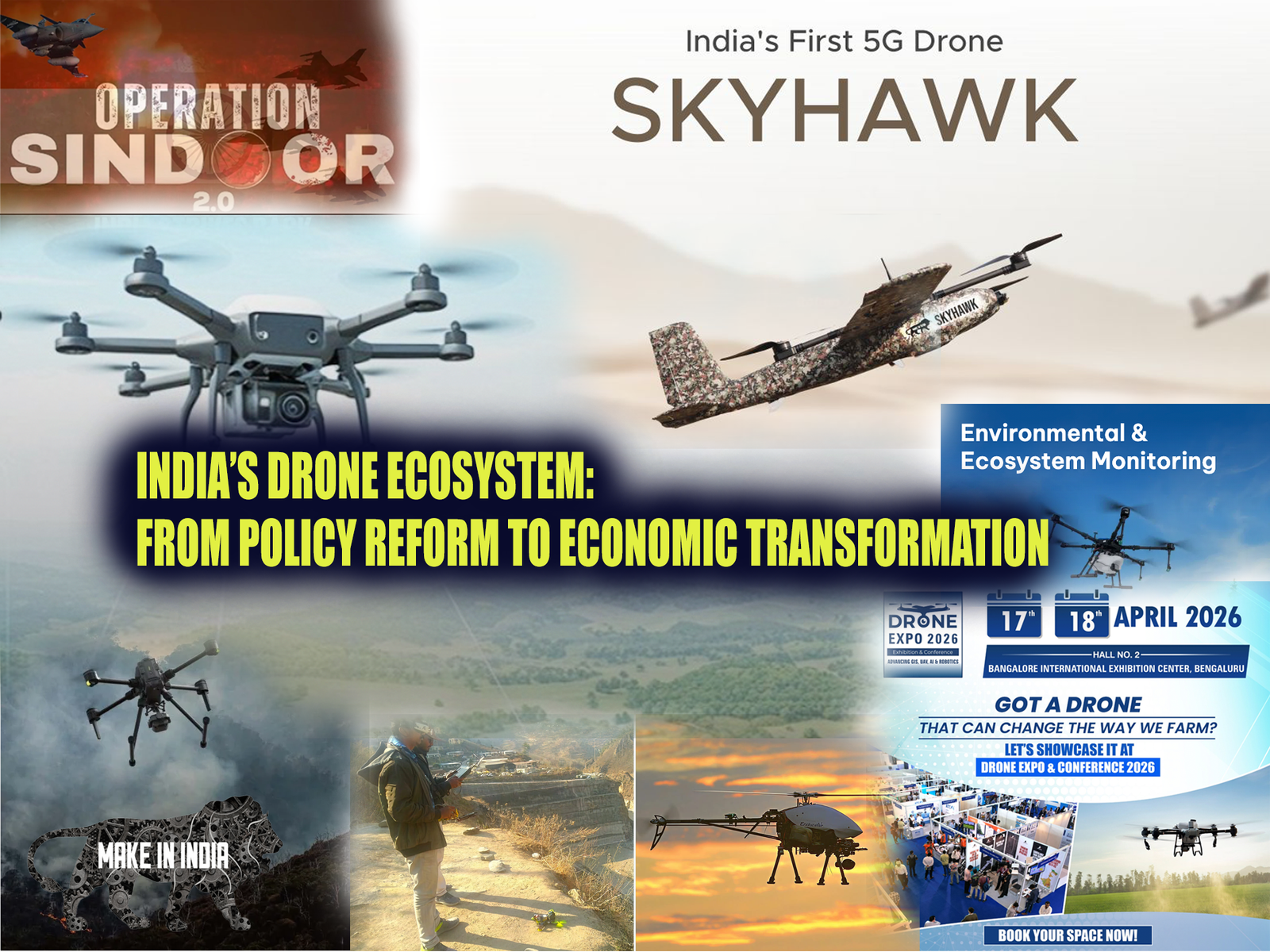
India’s Drone Ecosystem: From Policy Reform to Economic Transformation
India’s drone ecosystem has evolved from a limited experimental technology space to a structured, innovation-driven growth sector. Backed by progressive policy reforms, increasing user adoption, manufacturing incentives, and startup participation, the India drone ecosystem growth story is becoming one of the most significant technology transformations in recent years.
As of February 2026, India has:
- 38,575+ registered drones (UIN)
- 39,890 DGCA-certified remote pilots
- 244 approved Remote Pilot Training Organisations (RPTOs)
This rapid expansion signals not just regulatory maturity but also growing demand across agriculture, infrastructure, governance, and defence sectors.
Policy Reforms That Accelerated India’s Drone Ecosystem Growth
The turning point came with the introduction of the Drone Rules, 2021, followed by amendments in 2022 and 2023.
Key Reforms:
- Reduction of forms from 25 to 5
- Approval steps reduced from 72 to 4
- Nearly 90% of Indian airspace declared Green Zone
- Remote Pilot Certificate replaced traditional pilot licence
- Civil drone operations allowed up to 500 kg
- Passport requirement removed
These reforms drastically reduced entry barriers and encouraged startups, MSMEs, and service providers to enter the drone ecosystem.
Digital Infrastructure: Enabling Compliance and Adoption
India’s regulatory ecosystem is digitally driven through:
- Digital Sky Platform
- eGCA integration for registrations and certifications
The Digital Sky platform has ensured transparent registration, airspace approvals, and compliance management — making drone operations more accessible and scalable.
Rising User Base: Drones in Everyday Governance
The biggest sign of India drone ecosystem growth is the expanding user base across government schemes and industries.
1. Land Mapping Revolution – SVAMITVA Scheme
Under the SVAMITVA Scheme:
- 3.28 lakh villages surveyed using drones
- 2.76 crore property cards prepared
- Implemented across 31 States and UTs
Drone-based land mapping has reduced disputes, improved transparency, and enhanced rural access to institutional credit.
2. Agriculture Modernization – Namo Drone Didi Scheme
Launched in November 2023, the Namo Drone Didi Scheme has transformed agricultural service delivery.
Impact Highlights:
- 1,094 drones distributed to Women SHGs
- 500+ under Namo Drone Didi initiative
- Boost to precision farming and income generation
Women-led SHGs are now offering drone spraying services, reducing input costs and improving crop productivity.
3. Infrastructure Monitoring and Development
The National Highways Authority of India mandates monthly drone monitoring of highway projects.
Drones are used for:
- Construction progress tracking
- Dispute resolution documentation
- Real-time infrastructure analytics
Similarly, the Indian Railways uses UAVs for:
- Track inspections
- Bridge monitoring
- Security surveillance
This has significantly improved maintenance efficiency and reduced manual inspection risks.
4. Disaster Management & National Security
Institutions like the North East Centre for Technology Application and Reach have deployed drones for flood and landslide monitoring.
In defence operations, drones play a critical role in:
- Border surveillance
- Intelligence gathering
- Precision targeting
This multi-sectoral adoption indicates a rapidly expanding operational base.
Manufacturing Startups: Building an Atmanirbhar Drone Industry
One of the most important aspects of India drone ecosystem growth is the rise of domestic manufacturing startups.
Production Linked Incentive (PLI)
The PLI scheme for drones has an outlay of ₹120 crore to promote indigenous manufacturing of:
- Drone airframes
- Sensors
- Navigation systems
- Software solutions
The scheme enables Indian startups and MSMEs to scale operations, reduce import dependency, and position India as a global drone manufacturing hub.
GST Reduction: Boosting Commercial Adoption
In September 2025, GST on drones was reduced to 5%, replacing earlier 18% and 28% slabs.
This move:
- Reduced operational costs
- Boosted commercial demand
- Strengthened training institutes
- Encouraged Drone-as-a-Service (DaaS) models
Lower taxation has expanded both enterprise and rural adoption.
Skill Development: Expanding the Talent Pool
India now has 244 DGCA-approved RPTOs and nearly 40,000 certified remote pilots.
Skill-building initiatives include:
- Bharat Drone Shakti
- Drone Mahotsav
- National Innovation Challenge for Drone Application and Research (NIDAR)
- SwaYaan capacity-building programs
These initiatives are strengthening India’s talent pipeline and supporting industry expansion.
How India’s Drone Ecosystem Contributes to Economic Growth
India drone ecosystem growth is contributing to the economy in multiple ways:
1. Job Creation
- Remote pilots
- Drone engineers
- Manufacturing technicians
- Software developers
- Data analysts
The ecosystem creates both direct and indirect employment.
2. Boost to Manufacturing & MSMEs
With PLI support and reduced compliance, startups are scaling manufacturing capacities. This:
- Encourages domestic component production
- Reduces import dependency
- Strengthens the Make in India initiative
3. Increased Agricultural Productivity
Precision spraying reduces:
- Fertilizer waste
- Crop damage
- Labor costs
Higher yields translate into stronger rural income growth.
4. Improved Governance Efficiency
Drone-based monitoring:
- Reduces project delays
- Enhances transparency
- Cuts corruption risks
- Speeds up land dispute resolution
Efficient governance directly contributes to economic productivity.
5. Export Potential
With rising domestic capability, India is positioning itself as a competitive exporter of:
- Commercial drones
- Surveillance drones
- Agricultural drone solutions
This will contribute to foreign exchange earnings in the coming years.
The Future of India’s Drone Ecosystem
India’s drone ecosystem is moving toward:
- Indigenous component manufacturing
- AI-integrated autonomous drones
- Expanded rural applications
- Public-private innovation partnerships
With policy stability, startup momentum, and rising user adoption, India is on track to become a global leader in unmanned aerial systems.
Here’s a list of notable Indian drone manufacturing startups and companies that are successfully contributing to the growth of the India drone ecosystem, including approximate business metrics where available.
Note: These are estimated figures based on company reports, press releases, and industry research as of late 2025 / early 2026.
| Startup / Company | Estimated Business Volume / Revenue | Funding / Investment Highlights | Key Application Areas |
|---|---|---|---|
| Garuda Aerospace | ₹100 Cr+ annual revenue (2025 est.) | Series B – ₹100 Cr | Agriculture spraying, DaaS, mapping, security |
| IdeaForge Technology | ₹450 Cr+ total revenue (2025 est.) | Private equity & strategic partnerships | Defence UAVs, surveillance, industrial inspection |
| Asteria Aerospace | ₹150 Cr+ (approx.) | Owned by Reliance Industries / Jio Platforms | Commercial mapping, AI analytics, infrastructure monitoring |
| IG Drones | ₹22 Cr (FY25) → target ₹100 Cr (FY26) | Angel & early-stage rounds | Smart cities, industrial monitoring, security |
| Zuppa Geo Navigation | ₹35 Cr+ (est.) | Seed & strategic investors | Autonomous navigation, defence platforms |
| Amber Wings | ₹40 Cr+ (est.) | Institutional grants & DGCA support | Hybrid cargo drones, logistics applications |
| AUS – Aarav Unmanned Systems | ₹50 Cr+ (est.) | Venture & revenue-led scaling | Surveying, GIS, land mapping |
| Raphe mPhibr | ₹200 Cr+ (est. via global projects) | $145M funding round (~₹1,200 Cr) | High-end defence & autonomous drone systems |
Conclusion
India’s drone ecosystem growth represents a powerful blend of policy reform, startup innovation, digital governance, and mass adoption.
From surveying 3.28 lakh villages under the SVAMITVA Scheme to empowering women under the Namo Drone Didi initiative, drones are transforming agriculture, infrastructure, disaster management, and defence.
With expanding manufacturing, rising certified pilots, reduced GST, and PLI-backed startups, the drone sector is not just a technology trend — it is becoming a major contributor to India’s economic growth, employment generation, and global competitiveness.
India’s drone ecosystem is no longer emerging — it is accelerating toward becoming a strategic growth pillar of the nation’s digital and industrial future.
About The Author
Discover more from Jist Feed
Subscribe to get the latest posts sent to your email.