

Bangladesh at a Political Crossroads
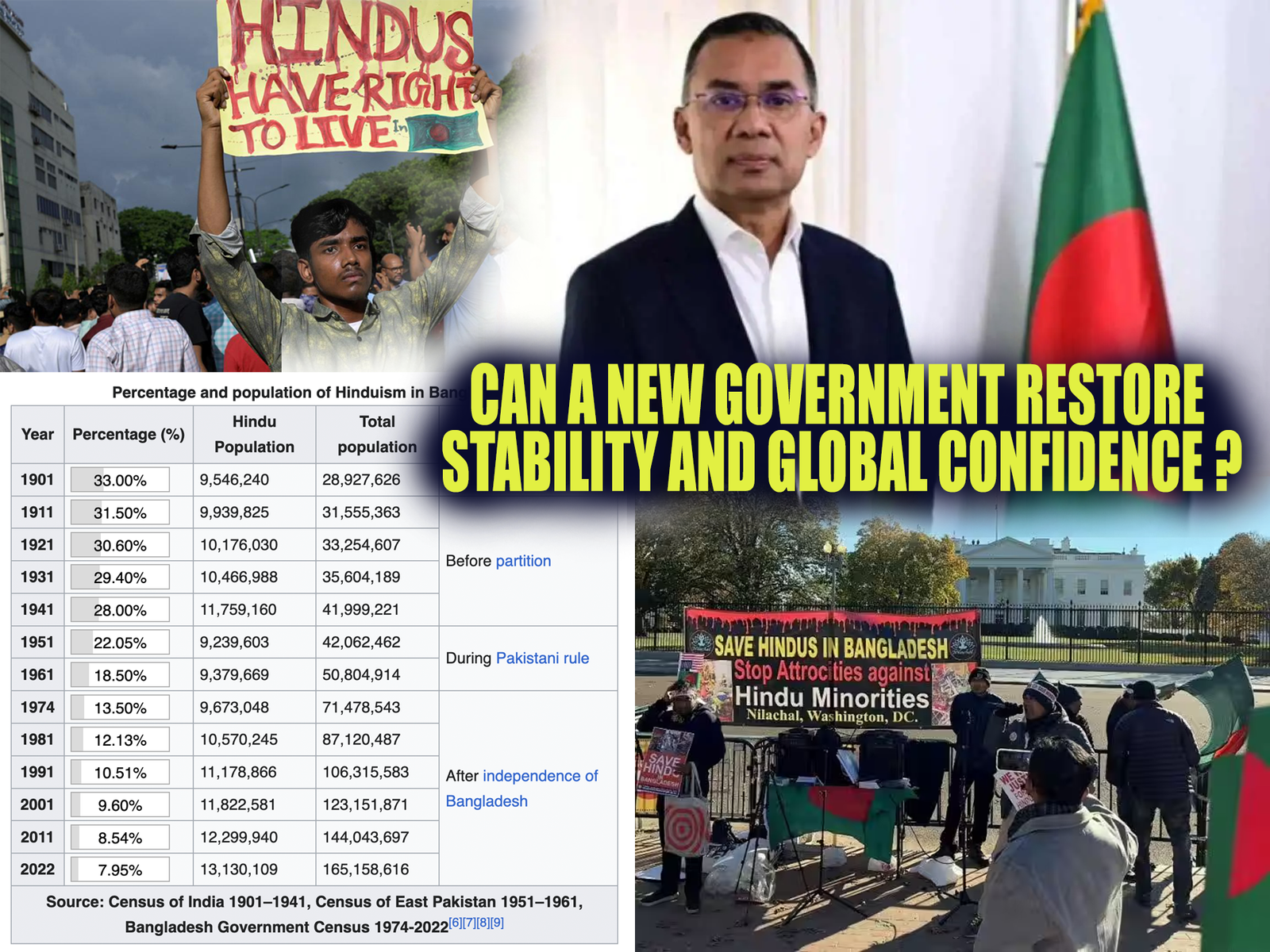
Bangladesh stands at a defining political moment. With discussions intensifying around Tarique Rahman’s potential leadership and the formation of a new government, national and international observers are closely examining what such a transition could mean for governance, economic stability, and—most critically—the safety of minority communities, particularly Hindus.
As the acting chairman of the Bangladesh Nationalist Party (BNP) and son of former Prime Minister Khaleda Zia, Tarique Rahman has remained a central figure in Bangladesh’s opposition politics for over a decade. Educated abroad and currently residing in the United Kingdom, Rahman represents a generational shift within BNP leadership. The critical question now is whether a government under his leadership would strengthen democratic institutions and guarantee minority rights.
Demographic Reality: The Position of Hindus in Bangladesh
According to the 2022 Bangladesh Population and Housing Census, Hindus constitute approximately 7.9% of the country’s population, representing nearly 13 million citizens. Historically, this percentage has declined from around 13% in 1974, reflecting migration trends, demographic shifts, and socio-political developments.
Bangladesh’s Constitution formally recognizes equal rights for all citizens regardless of religion. However, periodic incidents of communal tension have drawn attention from international human rights organizations.
- Episodes such as the 2021 Durga Puja violence, widely reported in domestic and global media, raised serious concerns about law enforcement effectiveness and minority protection mechanisms.
- Recent incidents in July 2025 at Gangachara Upazila, Rangpur District, around 15–20 Hindu homes were vandalised, looted and attacked by mobs, forcing many families to flee their village amid communal tension.
- Lynching of Dipu Chandra Das a Hindu garment worker, was beaten, lynched and his body burned by a mob on allegations of blasphemy.
- In this February, in Mymensingh District, 62-year-old Hindu trader Susen Chandra Sarkar was brutally hacked to death inside his shop just days before nationwide elections.
- In separate incidents in Moulvibazar and Mymensingh districts, two Hindu men were killed a day before national polls, raising alarm over violent targeting of minority community members.
- In Shariatpur District, Hindu businessman Khokon Chandra Das was stabbed and set on fire by assailants and succumbed to his injuries days laterKilling of Khokon Chandra Das on December 31, 2025.
These realities frame the current debate: Can a new BNP-led government provide stronger safeguards for minorities and prevent future communal unrest?
Tarique Rahman’s Leadership Profile
Tarique Rahman’s political image combines legacy, controversy, and reformist rhetoric. As the son of former President Ziaur Rahman, he carries the symbolic weight of BNP’s founding ideals—nationalism, economic liberalization, and multi-party democracy.
Supporters argue that:
- He represents a foreign-educated, globally aware leadership model.
- He understands the urgency of restoring Bangladesh’s international reputation.
- He may prioritize institutional reform and economic modernization.
Critics question:
- His prolonged absence from domestic politics.
- Legal cases filed against him in Bangladesh.
- Whether BNP can decisively distance itself from extremist elements.
The global community will assess not rhetoric, but governance performance—particularly in law enforcement, judicial independence, and minority protection.
Minority Safety: Core Concerns and Policy Expectations
1. Law Enforcement Reform
One of the primary concerns voiced by rights observers is the effectiveness and neutrality of law enforcement agencies during communal tensions. A new government would need to:
- Establish rapid response units to address attacks on minority.
- Strengthen accountability mechanisms within police structures.
- Ensure transparent investigations into any attacks on religious institutions.
Institutional credibility will depend on measurable improvements, not political statements.
2. Judicial Accessibility and Rule of Law
Concerns about delayed justice and prolonged litigation processes have impacted public confidence. Minority communities often cite:
- Lengthy legal procedures.
- Land dispute vulnerabilities.
- Inconsistent prosecution outcomes.
A reform-oriented administration could introduce:
- Special tribunals for communal violence cases.
- Fast-track courts for minority-related property disputes.
- Digital transparency systems to track case progress.
Restoring faith in the judiciary would be pivotal in reassuring vulnerable communities.
3. Countering Radicalization and Hate Narratives
Bangladesh has historically maintained a moderate Islamic identity. However, sporadic incidents of radical rhetoric have surfaced over the years. Ensuring minority safety requires:
- Strong monitoring of hate speech and violence on minorities.
- Cyber surveillance against incitement.
- Community engagement programs promoting interfaith harmony.
Economic inclusion and education reforms would also reduce susceptibility to extremist narratives.
Economic Development and Its Link to Social Stability
Economic growth remains one of Bangladesh’s strongest global narratives. Over the past decade, the country has maintained:
- Average GDP growth rates above 6%.
- Major infrastructure projects including the Padma Bridge.
- Rising export performance in the ready-made garment sector.
A Tarique Rahman-led government would need to sustain macroeconomic stability while addressing inflation, unemployment, and foreign reserve pressures. Social stability is closely tied to economic opportunity. Marginalization often intensifies during economic downturns.
International Reputation and Diplomatic Balancing
Bangladesh’s geopolitical position between India and Southeast Asia makes diplomatic balance essential. Allegations of anti-India sentiment or communal polarization can negatively affect trade, security cooperation, and global perception.
A future government would need to:
- Reinforce bilateral relations with India.
- Maintain strategic ties with Western partners.
- Uphold commitments under international human rights frameworks.
Foreign investors and global institutions will closely observe governance indicators before increasing engagement.
BNP’s Historical Record and Public Expectations
The BNP governed Bangladesh in multiple terms, most recently from 2001 to 2006. That period witnessed both economic initiatives and political controversies. Public expectations today differ significantly from two decades ago.
Modern voters prioritize:
- Digital governance.
- Transparent economic management.
- Minority protection and communal harmony.
- Independent institutions.
To succeed, a new BNP government would need to demonstrate a clear break from past governance short comings while articulating a forward-looking reform agenda.
Development Path or Political Vulnerability?
A central debate remains whether a Tarique Rahman-led administration would firmly uphold secular constitutional commitments or face pressure from conservative factions. Political stability depends on:
- Coalition management.
- Internal party discipline.
- Zero tolerance for communal violence.
- Clear public messaging against extremism.
Strong institutional frameworks—not personalities—ultimately determine democratic resilience.
Minority Assurance: What Would Genuine Security Look Like?
Minority communities will assess credibility based on tangible indicators:
- Decline in communal incident statistics.
- Convictions in violence-related cases.
- Restoration of damaged religious sites.
- Public inclusion in policy making forums.
Symbolic gestures must translate into systemic change.
The Road Ahead for Bangladesh
Bangladesh’s future trajectory hinges on governance quality rather than political slogans. If Tarique Rahman assumes leadership and forms a government, success will depend on:
- Rebuilding public trust.
- Strengthening the rule of law.
- Ensuring minority protection.
- Maintaining economic momentum.
- Restoring international confidence.
The global community, domestic civil society, and minority groups will closely evaluate whether policies reflect constitutional guarantees of equality.
Bangladesh possesses immense human capital, strategic geographic advantages, and a resilient economy. The challenge is converting political transition into inclusive national progress.
A government that prioritizes institutional reform, communal harmony, and sustainable development can redefine Bangladesh’s global image. Failure to address minority concerns decisively, however, would risk further polarization and reputational damage.
The coming period will determine whether leadership transition becomes a turning point toward stability—or a continuation of unresolved tensions.
About The Author
Discover more from Jist Feed
Subscribe to get the latest posts sent to your email.