

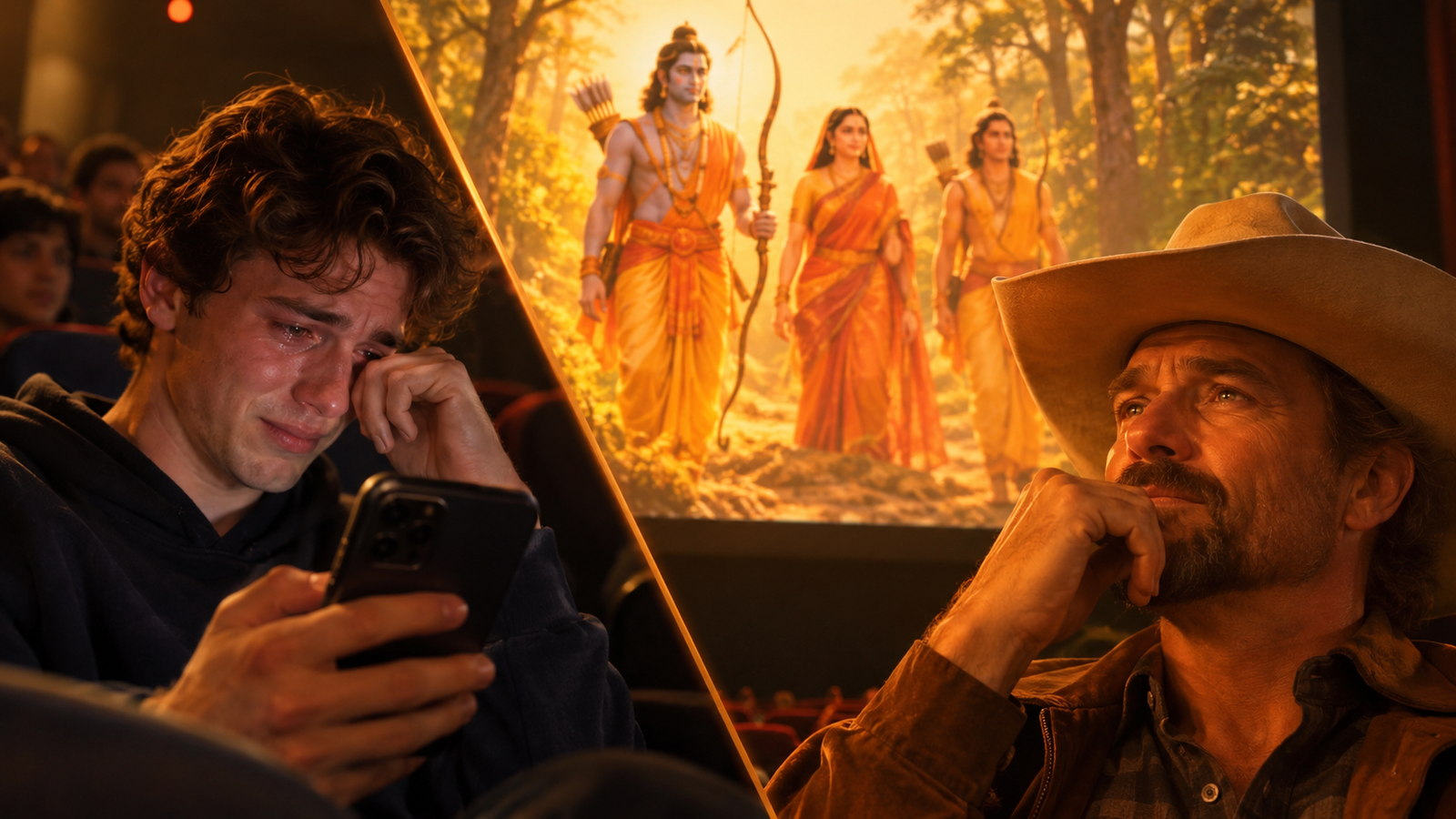
One reviewer texted “I love you” to his parents; another began questioning what kind of man he is. Two American critics’ reactions point to a worldwide pattern.
For several days, reviews of Ramayana (Part 1) have been arriving from across the world. One thing stands out: foreign viewers are talking less about technical craft and far more about Ram’s character, the story’s values, life lessons and Indian culture.
This report places two American critics’ reactions side by side. Both came to the epic as near-strangers, and both left the theatre deeply moved.
Reviewer One: “The Exile Scene Showed Me Why India Loves Ram”
This critic went in with “zero expectations”. His early question was why he should follow a man born into wealth and power.
The answer came in the exile scene just before the coronation. Told by his stepmother that he must go into exile for 14 years, Ram does not get angry. He says she only needed to ask, and that a promise his father made must be kept. The critic says that was the moment he became a fan, and he praised Ranbir Kapoor’s restrained performance.
When Dasharatha collapses, he teared up and texted his parents “I love you”. He described Ram and Sita’s bond as built on respect, trust and mutual service, and praised Sai Pallavi’s Sita. On Ram versus Ravana, he said the film never preaches yet makes the difference clear: Ram is restrained and dutiful, Ravana egotistical and ruling through fear. He hopes men in America and the West will see that muscle and swagger do not define manhood. He also credited the enthusiasm of thousands of Indian viewers, who wrote to him after his trailer reaction, for his excitement going in.
Reviewer Two: “I Kept Thinking About My Own Life Days Later”
The second critic, a Texan in his fifties, calls himself a “student”, not an expert, and says he had barely heard of the Ramayana before. He came for the spectacle and “stayed for the story”.
On the film itself, he calls it a fairly “Americanized” Indian blockbuster, with a Part One running over three hours. Yash’s Ravana, with a layered storyline tracing his rise from slavery to power, was the part that interested him most, though he does not root for him.
His review is built around life lessons:
- Dharma and duty (Ram): Doing right is easy when all is going well; the test is when it costs you. The question should shift from “what’s best for me?” to “what’s right?”
- Loyalty (Lakshmana): Many are loyal in good times; real loyalty is showing up through struggle. One loyal person is worth more than a hundred cheering voices.
- Love and strength (Sita): Love is something you practise, not just feel. Sita is neither passive nor dependent; she chooses to stand beside Ram.
- The danger of power (Ravana): Intelligence and ambition without humility can destroy a man. Confidence turns into arrogance, ambition into obsession.
- Courage (Jatayu): Courage is not knowing you will win but refusing to watch wrong happen. The old bird’s fight told him you are never too old to be brave.
- Leadership and humility (Bharat): Many want titles; few want responsibility. Leadership is how responsibly you serve others.
- Keeping your word (Dasharatha): Be careful what you promise and who you listen to, and avoid decisions made from fear, jealousy or selfishness.
- Self-control: We cannot control what happens, but we can control our anger, ego and choices. Sometimes strength is restraint.
- Good people suffer: Ram’s virtue does not spare him pain. A setback does not mean purpose is lost; the path may change.
He closed with questions for himself: Am I living by my principles? Am I showing up for the people I love? When life gets hard, do I choose the easy thing or the right thing? He called the film one of his favourite cinematic experiences of 2026 and invited viewers who grew up with the epic to tell him what he missed.
Expert Analysis: Why the World Is Responding This Way
1. Story first, technology second. Both reviews treat craft as secondary. The second critic says the film stayed with him not for explosions or effects but because it made him re-examine his life.
2. Values cross borders. Keeping one’s word, duty, loyalty, restraint and family responsibility belong to no single culture, so viewers anywhere can map them onto their own lives.
3. A mirror, not a sermon. Both critics note the film does not lecture. Audiences are left to ask which character they resemble, and that self-questioning may be the most notable feature of these reactions.
4. Restraint in an age of conflict. Against a backdrop of long-running wars and instability, a story about forbearance, humility and responsibility is read by many commentators as newly relevant.
5. The villain matters. The second critic preferred Yash’s Ravana as a character yet holds Ram up as the ideal. The film’s refusal to draw a flat villain seems to be what keeps viewers thinking.
6. Soft power. Unprompted, emotional responses from ordinary foreign viewers are often seen as more persuasive evidence of cultural influence than official promotion.
A caution: This report rests on two critics’ views. It would be wrong to generalise to all foreign audiences, and mixed opinions exist, such as the second critic’s remark about the film’s Hollywood-style blockbuster approach. Even so, the pattern is notable: the conversation is about values, not technology.
Conclusion
Once again, the Ramayana’s story has shown that its appeal is not confined by race, religion or national borders. It has also underlined, once more, that Hinduism is not merely a mode of worship but a way of life. With people from East to West expressing such affection for this epic, the responsibility and duty of Indians to uphold its dignity has grown many thousand times over.
About The Author
Discover more from Jist Feed
Subscribe to get the latest posts sent to your email.